

Marketing Psychology: 5 Principles That Influence Customers
What is Marketing Psychology?
Marketing psychology is a fairly self-explanatory term — it refers to incorporating principles of psychology into your marketing. With marketing psychology, you strategically plan out your marketing to influence consumer decisions and behavior.
Some people even work as marketing psychologists, coming up with marketing strategies that are based on psychological research. The more you know about human behaviors, thoughts and actions, the more effective your marketing will be.

Why is Marketing Psychology Important?
Marketing psychology can be hugely effective in helping you drive more sales and see better results from your marketing campaigns. Whether your customers realize it or not, there’s a lot of psychology that goes on when they’re making a purchasing decision.
If you know what’s happening behind the scenes, you’ll be able to craft marketing tactics and campaigns that work to your advantage in helping consumers make a purchase. And in the long-term, your digital business will see more sales and better results.
Principles That Influence Consumer Behavior
Marketing Psychology Principle #1 – Social Proof
According to the principle of social proof, people make decisions based on the behavior of others. How does this relate to marketing?
People are more likely to buy from a company when they see other people using and enjoying products from that company. Positive reviews, high numbers of active users, and positive user-generated content (UGC). All make it more likely that a potential customer will buy from your brand.
Utilizing social proof as a brand is particularly helpful for attracting new shoppers.
Marketing Psychology Principle #2 – Scarcity
Rare items are valuable. Think about precious gems, such as emeralds or rubies—their scarcity makes them worth more. This is the scarcity principle in action.
This psychological principle states that people place a higher value on items if there is a perceived shortage. And it goes beyond precious gems. One study found that people rated identical chocolate chip cookies more highly when there were fewer cookies available.
Applied to marketing, the scarcity principle means that consumers are more likely to buy something or pay more for it if they think the product is in short supply.
Marketing Psychology Principle #3 – Reciprocity
When someone gives you a gift, do you feel compelled to give them something in return (or at least feel guilty if you didn’t get them anything)? In psychology, this is called the norm of reciprocity.
In marketing psychology, the reciprocity norm means consumers often feel somewhat indebted to a company if the business gives them a product for free.
Say, for example, a gardening supply company sends out surveys and a free packet of seeds to current customers. Because the company has given them a gift, shoppers will likely feel obliged to fill out and return the survey.
Marketing Psychology Principle #4 – Loss Aversion
As its name suggests, the loss aversion principle refers to people’s preference for avoiding a loss over gaining an equal amount.
For example, we are more upset over losing $20 than we are happy about finding $20. Why do we act this way? Possibly because strong anxiety and fear are associated with loss, and negative emotions are shown to have a stronger, more lasting impact on people than positive ones.
The loss aversion and scarcity principles seem similar, but the focus is different for each.
With scarcity, you are emphasizing that there is a limited supply of an item, but with loss aversion, there is no concern with supply. To invoke loss aversion, you are letting consumers know they might lose something they already have.
Marketing Psychology Principle #5 – Anchoring Bias
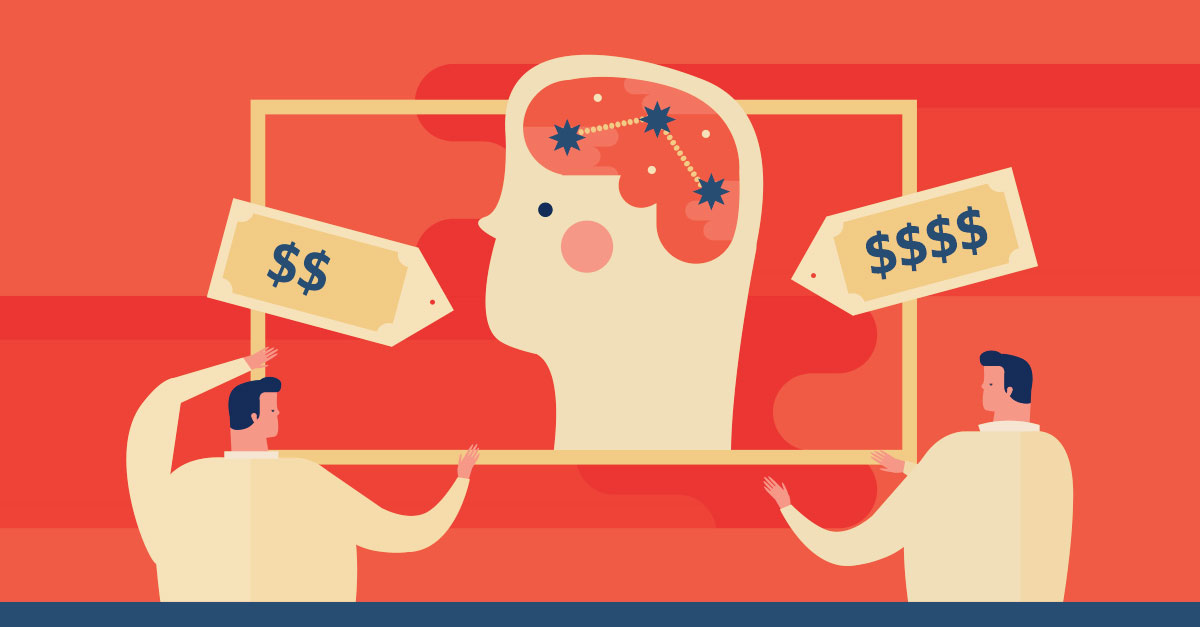
Anchoring bias tells us that our decision-making is heavily influenced by the first piece of information we get that’s related to that decision.
In terms of marketing, the anchoring bias means that customers evaluate prices and products based on the first information they receive.
Let’s say a consumer goes to one store and sees jeans priced at $100. But the same jeans are $50 at the next store. The $50 jeans seem like a really good deal, even if the person might not normally pay $50 for jeans.