


Is ChatGPT the Next Big Advertising Channel for Marketers?
For decades, the digital advertising landscape has been dominated by two titans: search and social. Marketers have perfected the art of capturing user intent on Google and engaging audiences on platforms like Instagram and Facebook. However, a new frontier is rapidly emerging, one that promises to blend the intent of search with the personal nature of a social chat: advertising within conversational AI.
At the forefront of this shift is ChatGPT. With hundreds of millions of users turning to it for answers, recommendations, and creative assistance, the question is no longer if it will become an advertising channel, but how—and what that means for marketers.
As of late 2025, while you won’t see banner ads or pop-ups, the groundwork is actively being laid. OpenAI is building an internal advertising team and exploring “tasteful” ways to monetize its massive free user base. Consequently, for forward-thinking marketers, now is the time to understand this new channel and prepare for its inevitable arrival.
How Advertising Could Work in ChatGPT
Forget everything you know about traditional display ads. Advertising in a conversational interface will be a completely different game, focusing on value and context rather than interruption. The future of ChatGPT advertising will likely revolve around seamlessly integrating brand messages into the flow of a user’s conversation.
Here are the most likely formats we can expect:
- Sponsored Answers and Contextual Mentions: This is the most natural and anticipated format. Imagine a user asking, “What are the best CRMs for a small business in Lebanon?” Alongside the organic answer, a sponsored mention for a specific CRM could appear, clearly labeled as “Sponsored” but integrated directly into the helpful response.
- Why it’s powerful: This model targets high-intent users at the exact moment of consideration, much like search ads, but in a more trusted, advisory context.
- Affiliate Recommendations and Product Discovery: When a user asks for product recommendations—for example, “Find me a good pair of noise-canceling headphones for under $200″—ChatGPT could surface relevant products. While OpenAI currently states these are not ads, it’s a natural next step for these to become sponsored placements or include affiliate links.
- Why it’s powerful: This moves beyond advertising into “assisted commerce,” where the AI acts as a personal shopper, guiding the user directly towards a purchase.
- Brand-Powered Knowledge and “How-To” Guides: For more complex queries, ChatGPT could cite a sponsored guide or tool from a brand. For instance, if a user asks, “How do I create a digital marketing budget?,” the AI could respond with a summary and include a link to a comprehensive budget template provided by a marketing software company.
- Why it’s powerful: This format positions your brand as an authoritative expert and provides genuine value, building trust and capturing leads.
How is This Different from Google and Meta Ads?
The core distinction lies in the user’s mindset. On Google, users expect a list of options to research, and on social media, they are in a discovery or entertainment mode. On ChatGPT, users are in a collaborative, problem-solving mode. They are actively seeking a definitive answer or a trusted recommendation.
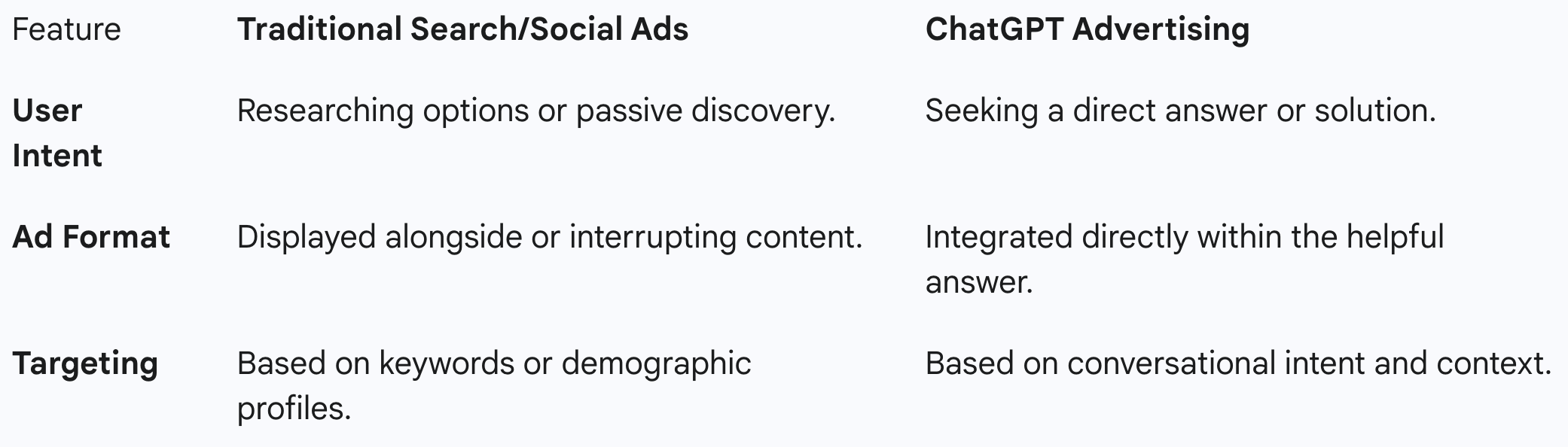
In essence, advertising on ChatGPT will be less about shouting for attention and more about being the most helpful voice in the room.
How Marketers Can Prepare Today
While you can’t buy an ad on ChatGPT just yet, the race for visibility has already begun. Here are three actionable steps you can take right now to prepare your brand.
- Master Generative Engine Optimization (GEO): The brands that will win in sponsored results are the ones that are already winning in organic results. Therefore, your primary focus should be on creating high-quality, factual, and well-structured content that AI models see as authoritative. The principles of Generative Engine Optimization (GEO)—answering questions directly, using conversational language, and building E-E-A-T (Experience, Expertise, Authoritativeness, Trustworthiness)—are the foundation for future advertising success.
- Develop Conversational Ad Copy: Start shifting your copywriting mindset from “click here” to “let me help you.” Begin crafting ad copy that is helpful, conversational, and sounds natural in a chat. Think in terms of providing solutions, not just listing features.
- Build Your Brand’s Authority Signals: AI models determine trust by analyzing a brand’s entire digital footprint. They look for mentions in high-authority publications, positive reviews, and a consistent presence across the web. Actively pursuing digital PR and building a strong online reputation will make your brand a more attractive candidate for the AI to feature, both organically and in future sponsored formats.
Conclusion: The New Conversation in Marketing
ChatGPT and other conversational AI platforms represent the next major shift in digital marketing. They are creating a new channel where brands can connect with customers in a more personal, contextual, and helpful way than ever before.
While the exact ad formats are still taking shape, the direction is clear. The future of advertising is not about interruption; it’s about integration. The marketers who understand this and begin adapting their content and strategies today will be the ones who lead the conversation tomorrow.
Ready to make AI data-driven decisions for your brand?
Creatives can help!
Our team of AI-powered digital marketing experts can guide you in harnessing the power of data to achieve your marketing goals.
Schedule a consultation to learn how our AI-powered solutions can drive growth.