

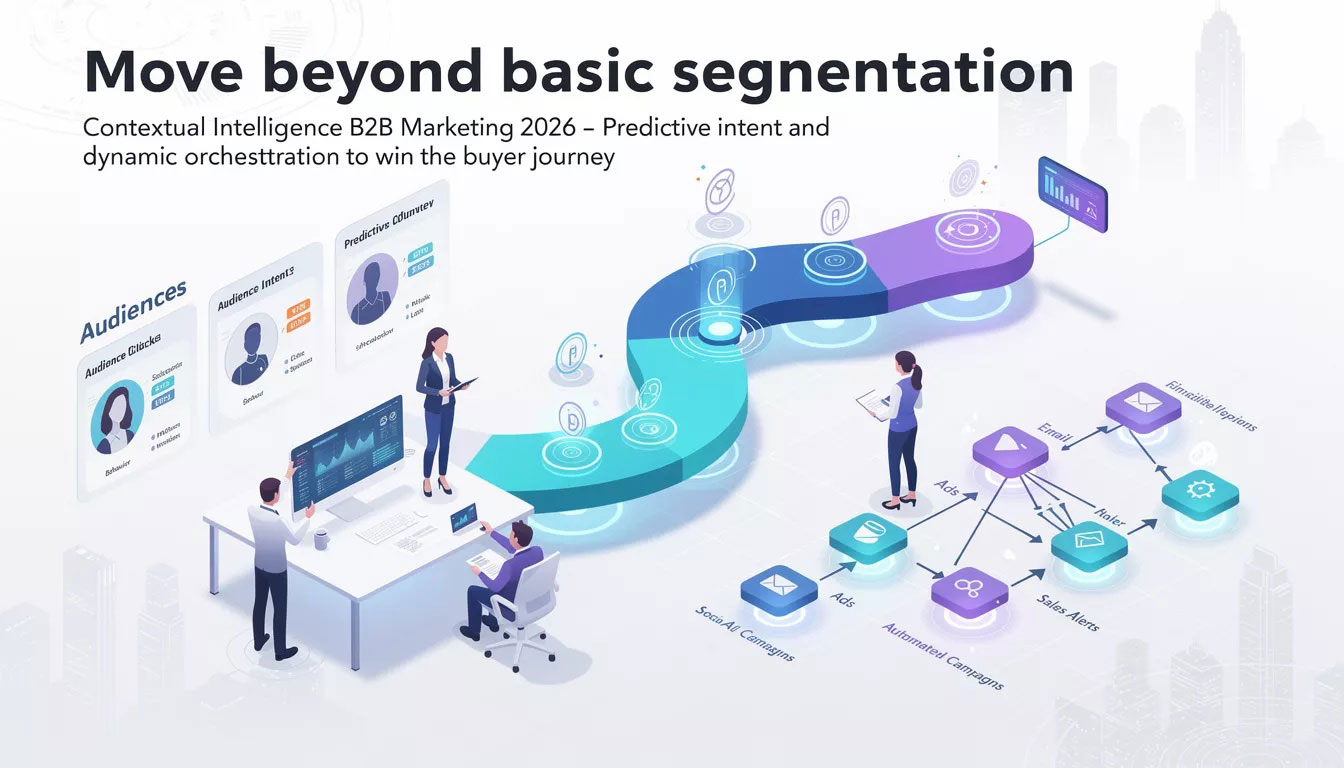
From Segments to Individuals: Using Contextual Intelligence to Anticipate the 2026 Buyer Journey
In the old world of marketing, we grouped people into “segments” based on their job titles or company size. We sent the same generic whitepaper to every “Director of IT” in the database. But in 2026, static segmentation is obsolete.
The new standard is Contextual Intelligence. It is the ability for your AI systems to combine a buyer’s historical data, real-time behavior, and organizational “life stage” to deliver a perfectly timed, individual experience. It’s not about who they are; it’s about where they are in their specific problem-solving journey.
1. The Anatomy of Contextual Intelligence
To move from “reactive” to “predictive,” your marketing stack must evolve. Contextual Intelligence gives your brand a “memory” and “awareness,” allowing it to interact more like a human expert than a digital billboard.
- Historical Depth: The system remembers every previous touchpoint, from an SDR call six months ago to a chatbot query yesterday.
- Real-Time Awareness: The system detects if the user is currently researching a competitor or browsing a specific technical spec.
- Organizational Life-Stage: The system knows if the prospect’s company just expanded into a new region or is facing a fresh regulatory deadline.
2. Three Strategic Pillars for 2026
Implementing Contextual Intelligence allows you to orchestrate the buyer journey with surgical precision across three key areas:
Pillar A: Predictive Intent Scoring (The “Early Warning” System)
Instead of waiting for a form fill, your AI identifies “High-Intent” signals from the “Dark Social” and “Zero-Click” world.
- The Use Case: An AI model detects that multiple stakeholders from the same target account are researching “Scalability issues with [Competitor Name]” in AI search engines. Your system automatically triggers a hyper-relevant LinkedIn ad for those stakeholders featuring your Case Study on Migration Success.
Pillar B: Dynamic Content Orchestration
Static landing pages are dead. In 2026, your website adapts its language and depth in real-time based on the user’s technical level and current “pain point.”
- The Use Case: A CFO landing on your site sees a dashboard-style ROI comparison. A Technical Architect landing on the same URL five minutes later sees a deep-dive API documentation hub and a “Try our Sandbox” call-to-action.
Pillar C: “Memory-Rich” Conversational Commerce
Whether it’s a chatbot, a voice-AI assistant, or a human SDR, the conversation must pick up exactly where it left off across channels.
- The Use Case: 81% of 2026 buyers expect agents to continue a conversation without backtracking. If a prospect asks your chatbot about pricing on Monday, and calls your sales line on Tuesday, the rep should immediately say, “I saw you were looking at our Enterprise Tier yesterday—did you have questions about the custom integration we discussed?”
3. The Takeaway: Measuring “Intent Lift”
In 2026, we stop measuring “clicks” and start measuring Intent Lift and Pipeline Velocity.
- Intent Lift: How effectively did your contextual outreach move a prospect from “Awareness” to “High-Intent” research?
- Pipeline Velocity: How much faster did deals close when the buyer was supported by a contextually aware journey?
The Takeaway
Contextual Intelligence turns your brand into a proactive partner rather than a passive vendor. In 2026, the brands that win will be those that use AI not to shout louder, but to listen more intently. By anticipating the buyer’s journey, you don’t just solve their problems—you provide the confidence they need to act.
Ready to make AI data-driven decisions for your brand?
Creatives can help!
Our team of AI-powered digital marketing experts can guide you in harnessing the power of data to achieve your marketing goals.
Schedule a consultation to learn how our AI-powered solutions can drive growth.