

Website Bounce: Definition & Importance
The percentage of visitors to a page on your website who subsequently leave is known as the bounce rate. They do not click on any other links or navigate to another page. They simply arrive on one of your website pages, browse around for a short while, and then depart.
In essence, they arrived at a website page, blog, or landing page, gave it a cursory glance, and decided it wasn’t the proper location. The visitor may have been looking for something and didn’t find it on your page, or they may have stumbled onto your site – in either case, your material was irrelevant.
Understanding bounce rate and how it affects your whole digital marketing strategy is crucial if you work in marketing. For instance, a high bounce rate could be a sign of technical SEO problems, like a delayed page load.
Comparing Bounce Rate and Exit Rate.
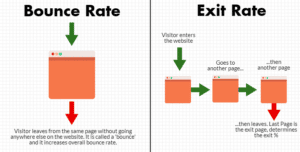
Exit rate, often referred to as drop off rate, and bounce rate, which measures the percentage of sessions that terminated on a web page, are two metrics that are frequently mixed up. However, the main distinction is that departure rate takes into account both single-page and multi-page sessions. Let’s examine the distinction between the definitions of bounce rate and exit rate:
- The percentage of all page views that were the final ones for the session is known as the exit rate.
- The percentage of sessions where only the landing page was viewed during the session is known as the bounce rate.
How Is The Bounce Rate Determined?
By dividing the total number of website entries by the number of one-page views, you may get your bounce rate. The bounce rate on that particular day would equal 50% if there were 500 visits to your website that day, and 250 of them left without initiating any further contact. As a result, it represents a percentage of all website views over a given time frame. The expression for the mathematical equation is as follows:
Rb = (Tv/Te)
The total bounce rate for your website is provided by Google Analytics, but you can monitor and track the bounce rate for certain pages using this calculation. For the purpose of optimizing specific web pages for search engines and analyzing user interaction, it is essential to comprehend this idea.
An Ideal Bounce Rate Is What?
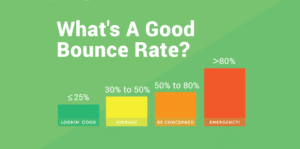 Understanding the distinction between a high bounce rate and a low bounce rate will help you determine what a decent bounce rate is for your website.
A high bounce rate indicates that a visitor’s time on your site is brief; after viewing one page, they quickly leave. A low bounce rate indicates that users are staying on a page for a while and using the links that are presented to them.
A high bounce rate isn’t always a negative thing, good or bad. The notion of a good bounce rate and a bad bounce rate are relative words that can vary based on a variety of factors, including arbitrary ones.
The importance of Bounce Rate.
The bounce rate shows how engaging your content is, making it a crucial SEO metric. A high bounce rate could indicate that website visitors are having trouble discovering what they’re looking for. It could also be an indication that you need to enhance your website’s user interface or content. Whatever the cause, it usually indicates that you are passing up chances to convert.
You may enhance the navigation, call to action (CTA) placement, and content quality on your website by conducting a thorough examination of your bounce rate.
The overall effectiveness of your website and goal completions are greatly influenced by bounce rates:
Your website won’t convert a visitor who leaves abruptly. Therefore, lowering the possibility of a visitor leaving your website will aid in raising the number of potential conversions.
Another significant Google Ranking Factor is bounce rate. Although there are differing views on this, for the best first page Google rankings, your SEO efforts should take bounce rate into consideration. (There are, however, certain exceptions to this, which we shall cover later.)
Visit quality is gauged by bounce rate. This indicator can therefore assist you identify whether your website (or a particular page within it) has problems with copywriting, page layout, user experience, or relevancy of the information.
Bounce Rate Tracking Techniques.
Drill down your material to find the best “sticky” stuff first. You may analyze your blogs, home page bounce rate, popular content, and their pertinent bounce rates using Google Analytics.
Next, look at the greatest traffic sources that have led the most people to your website, taking into account their individual bounce rates. You may view your top referrers, the strongest social referrers, and the traffic source with the highest bounce rate from this data.
Best keywords: By looking more closely at your traffic sources, you can learn which keywords have attracted the most people to your website and what percentage of those visitors bounced. By clicking the landing page link above the data, you can even discover which landing page keywords brought traffic to your website.
Ways to Reduce Bounce Rates.
You should think about factors that could raise your bounce rate if you wish to minimize it, such as:
- Sluggish page speed
- Pop-ups
- Unwanted plug-ins
- Poorly usable
- Meta descriptions and title tags that aren’t appropriately optimized
- Technical issues and missing pages
- Low-quality information
- Incompatible with mobile devices pages
- Incorrectly configured Google Analytics setup
The next step is to learn how to reduce your bounce rate now that you have a better understanding of what it is and why it is so crucial to the success of your website. The following suggestions are useful:
- Include links within your article to the pages of your website.
- Include links to articles that everyone will enjoy in your sidebar.
- Don’t stop at product pages
- Updating your content