

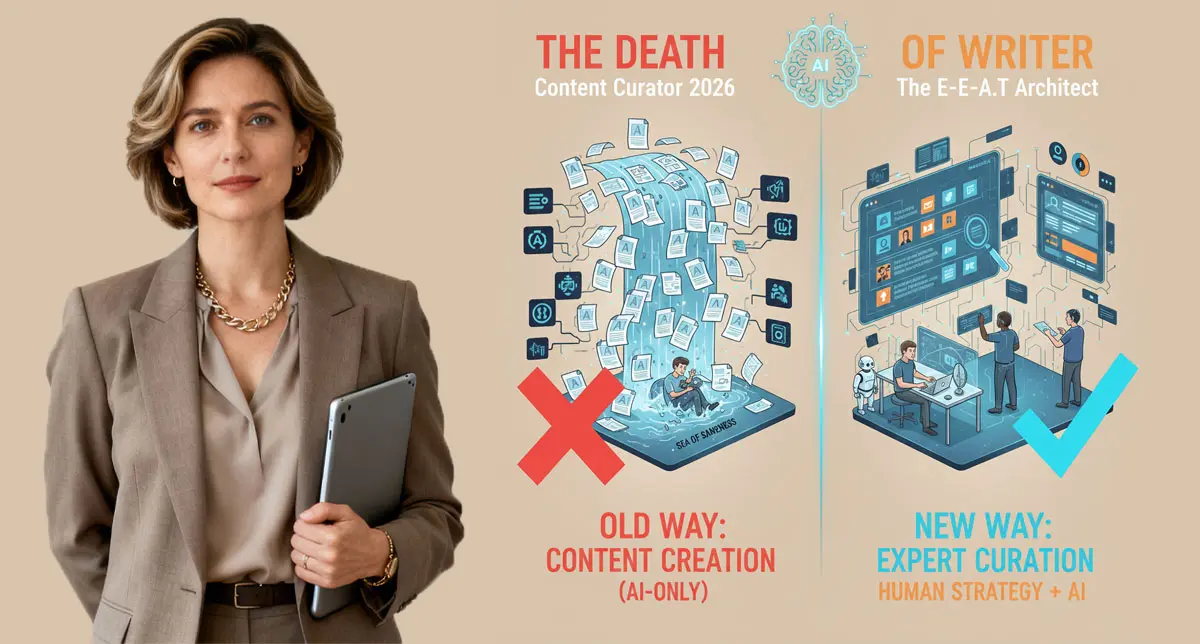
The Death of the Writer: Why Your 2026 Content Team Needs to Be Curators, Not Creators
Let’s ask the existential question that is currently terrifying every content manager in a budget meeting: “With Generative AI, do we still need writers?”
The answer is complex, but definitive: The job title of “Content Creator” is dead. The job title of “Expert Curator” is the single most critical hire you will make in 2026.
The problem is that AI has driven the cost of content creation to zero. You can flood the internet with generic blog posts for pennies. But that abundance is also the problem. AI has created “content shock”—a paralyzing sea of unverified, homogenous, unhelpful information.
In this environment, merely “creating” content is pointless. Your marketing success in 2026 will be determined by the content you curate, verify, and stamp with genuine human experience.
Here is the chain of thought for why the “Curator” is the new hero.
1. The Creator’s Job is Now Done by the Machine
The traditional role of the “Content Creator”—researching, drafting, and checking grammar—is now handled efficiently by AI. This frees up the human content expert to focus on high-value, high-leverage tasks.
The shift in skillset is massive: You no longer need someone who can write a 1,000-word article. You need someone who can manage the flow of information across your entire brand identity.
The Curator’s job is not to fill blank pages. It is to build the strategic framework that ensures every piece of content—whether human-written or AI-assisted—moves your brand closer to undisputed Topical Authority.
2. The 3 Pillars of the 2026 Expert Curator
The modern content specialist’s job is focused entirely on applying the human filter to the machine’s output. This is the difference between surviving and thriving in the E-E-A-T era.
Pillar 1: Verification and Trust (The Fact-Checker)
AI is a champion of hallucination. It can write a beautiful paragraph full of “facts” that are completely wrong.
- The Curator’s Role: The Curator’s job is to sit between the AI and the publish button. They must be the final human authority who verifies statistics, sources, and claims. They protect the brand’s Trust and ensure it avoids the massive penalties currently being levied by Google against misinformation.
Pillar 2: Infusing Experience (The Human Filter)
AI can write about the benefits of a product. It cannot tell a personal story about a product.
- The Curator’s Role: The Curator acts as an interviewer and editor. They must take the raw, expert knowledge from your CEO, your service team, or your technicians, and infuse that firsthand Experience into the content the AI generated. They infuse every article with the human voice, guaranteeing its authenticity and immunity from the “unhelpful content” filter.
Pillar 3: Strategic Curation (The Architect)
The biggest weakness of AI is strategy. It can’t plan your “Hub-and-Spoke” model, and it can’t anticipate market trends.
- The Curator’s Role: The Curator is the architect of your content calendar. They ensure that every piece of content—from a TikTok video to a detailed whitepaper—is strategically building towards Topical Authority on your core subject matter. They discard 50 AI-generated drafts and infuse the remaining two with human expertise before publishing them.
The Takeaway
The question for your 2026 content budget should not be, “How much should we pay our writers?”
It should be, “How much should we pay our Expert Curator to ensure the time we spend on content doesn’t get us penalized?”
Don’t budget for creation. Budget for curation. Pay for the human expertise that can guide the machine, and you will win the E-E-A-T war.
Ready to make AI data-driven decisions for your brand?
Creatives can help!
Our team of AI-powered digital marketing experts can guide you in harnessing the power of data to achieve your marketing goals.
Schedule a consultation to learn how our AI-powered solutions can drive growth.