

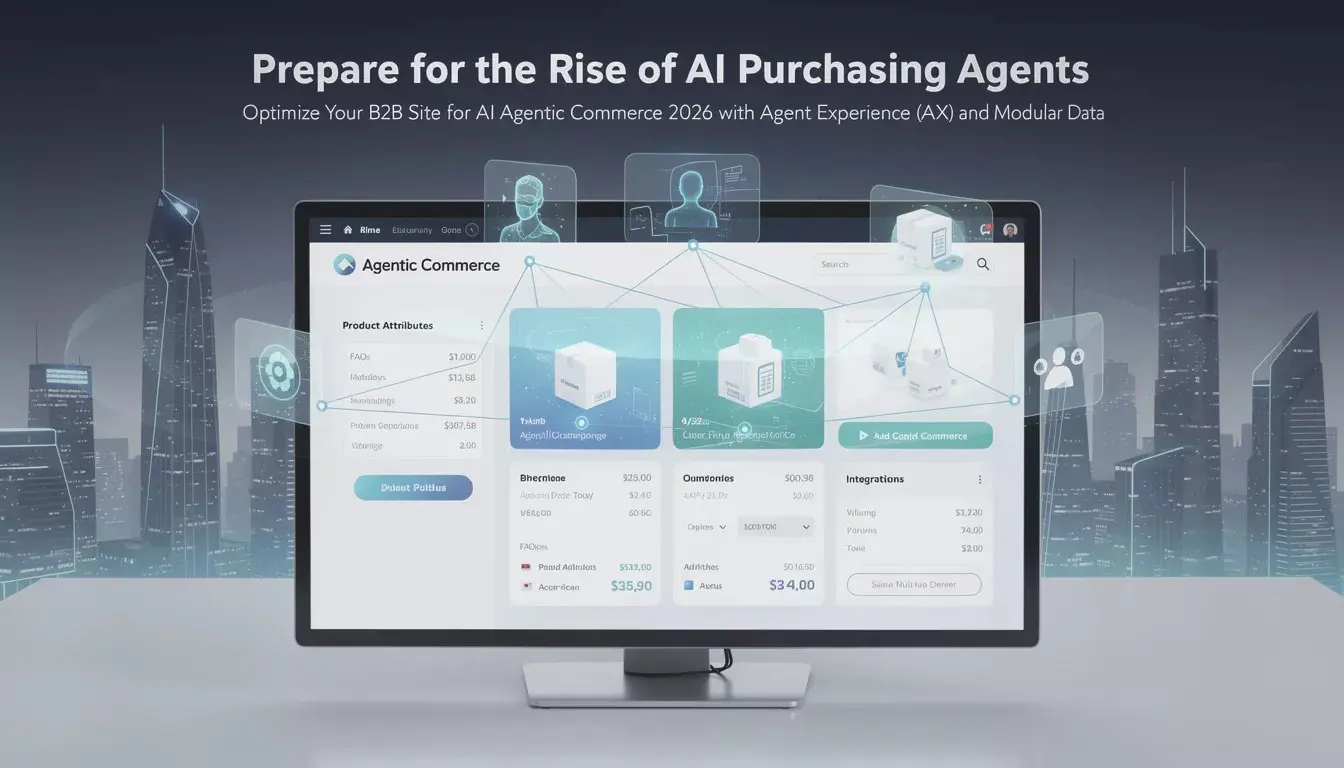
Selling to the Machine: Preparing Your B2B Infrastructure for AI Purchasing Agents
For decades, we designed websites for humans. We obsessed over button colors, emotive imagery, and persuasive copy. But in 2026, a significant portion of your B2B “visitors” aren’t humans—they are AI Purchasing Agents.
These autonomous agents are tasked by procurement departments to find the best vendors, match technical specifications, and compare pricing models across the web. They don’t care about your brand video; they care about data accessibility.
To win in 2026, you must transition from a “Website” mindset to a “Knowledge Hub” mindset. You are no longer just selling to people; you are selling to the machine.
1. From UX to AX: Designing for Agent Experience
Agent Experience (AX) is the science of making your business “legible” to autonomous AI. When a procurement agent (like a custom GPT or an enterprise Auto-GPT) lands on your domain, it needs to extract high-density information in milliseconds.
- The Barrier: PDF brochures, un-indexed “Contact for Pricing” gates, and text trapped inside images.
- The Solution: Modular Content. Every technical spec, service level agreement (SLA), and pricing tier must be available in a clean, machine-readable format (JSON-LD or highly structured HTML tables).
2. The Three Pillars of Agentic Readiness
To ensure your B2B brand is “discoverable” and “purchasable” by AI agents, your 2026 infrastructure must prioritize these three pillars:
Pillar A: Deep Schema Integration
Schema markup is no longer just for SEO; it is the API of the open web. You must use specialized Schema types to define the “DNA” of your offering.
- Tactics: Use Product, Offer, Service, and TechnicalSpec schemas to define your variables. This allows the agent to “understand” that your software has 99.9% uptime and SOC2 compliance without having to “read” your marketing fluff.
Pillar B: The “Agent-Friendly” API Layer
Leading B2B brands in 2026 are providing public-facing, read-only APIs or “Discovery Endpoints” specifically for AI agents.
- Tactics: Create a /well-known/ai-plugin.json or a dedicated .well-known directory that provides a map of your product capabilities. This acts as an “express lane” for agents to gather the data they need for a procurement report.
Pillar C: Transparent Logic (Not Just Prices)
AI agents are programmed to find the best value, not just the lowest price. They need to understand your logic.
- Tactics: Instead of “Starting at $500,” provide a Pricing Calculator or a structured logic table. Explain how volume discounts or regional tiers work. If the agent can calculate the exact cost for its “boss,” you are 10x more likely to be the recommended vendor.
3. The Takeaway: Measuring “Agent Share of Voice”
In 2026, your analytics must evolve. You will start tracking Bot-to-Human Lead Ratios.
- The Lead Gen Shift: A “lead” might now look like an AI agent requesting a formal quote via an API call or a structured form.
- The Success Metric: “Shortlist Inclusion Rate.” How often does an enterprise AI agent include your brand in the final comparison report delivered to the human decision-maker?
The Takeaway
If your B2B infrastructure is a “black box” that requires a human to click five times to find a price or a spec, you will be invisible to the automated economy of 2026.
By optimizing for Agent Experience, you aren’t just improving your SEO; you are building the infrastructure for the future of B2B commerce. You are making your business “machine-readable” and, therefore, “machine-buyable.”
Ready to make AI data-driven decisions for your brand?
Creatives can help!
Our team of AI-powered digital marketing experts can guide you in harnessing the power of data to achieve your marketing goals.
Schedule a consultation to learn how our AI-powered solutions can drive growth.