

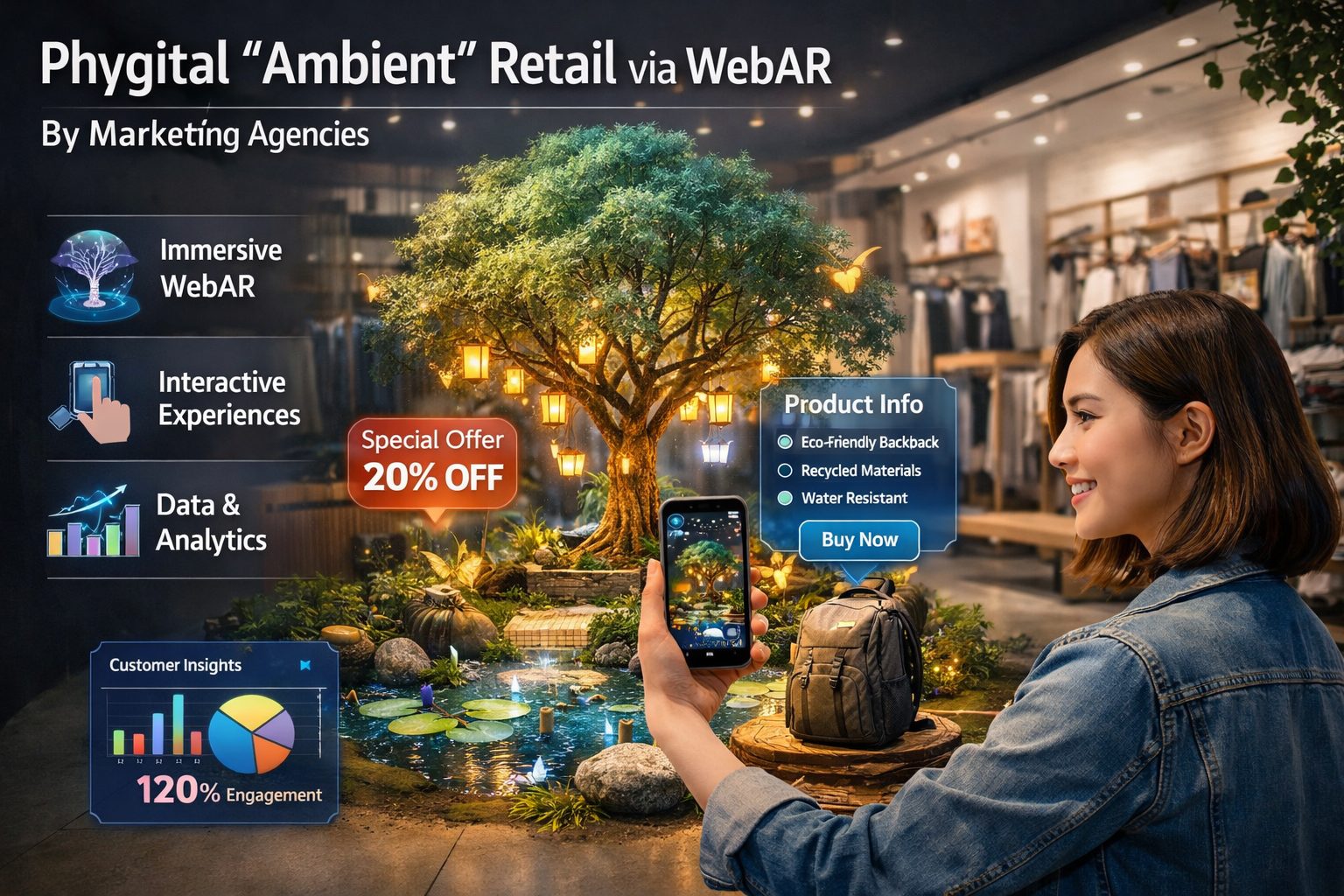
AI Phygital “Ambient” Retail via WebAR By Marketing Agencies
The retail experience is undergoing a profound transformation. While physical stores still play a vital role, digital interactions are increasingly shaping how consumers discover, evaluate, and purchase products. As a result, the concept of AI “phygital” retail—blending physical and digital experiences—has gained significant traction. Within this evolution, WebAR (Web-based Augmented Reality) is enabling what can be described as “ambient retail,” where shopping experiences are seamlessly integrated into everyday environments.
Moreover, consumers are no longer satisfied with static product displays or traditional online browsing. Instead, they seek interactive, immersive, and personalized experiences that allow them to engage with products in real time. Therefore, marketing agencies are leveraging WebAR to create dynamic retail environments that exist beyond the confines of physical stores or standard websites. An AI marketing agency in Lebanon, for instance, uses these technologies to bridge the gap between digital innovation and local consumer behavior.
Additionally, phygital ambient retail is not just about novelty—it is about utility and convenience. By embedding digital experiences into the user’s natural environment, brands can reduce friction in the buying journey and increase engagement. Consequently, businesses can deliver memorable interactions that drive both brand awareness and conversions.
Understanding Phygital Ambient Retail
First, phygital ambient retail refers to the integration of digital experiences into physical spaces in a way that feels natural and unobtrusive. Rather than requiring users to visit a store or website, the experience comes to them through their devices.
This approach typically includes:
- Embedding interactive product experiences into real-world environments
- Allowing users to visualize products through their smartphones
- Creating seamless transitions between online and offline interactions
- Delivering contextual content based on user location or behavior
- Enhancing everyday environments with digital overlays
- Reducing barriers between discovery and purchase
By integrating these elements, brands can create a more intuitive and engaging retail experience.
The Role of WebAR in Retail Innovation
At the same time, WebAR plays a central role in enabling these experiences. Unlike traditional AR applications that require downloads, WebAR operates directly within a browser, making it more accessible and user-friendly.
Key advantages of WebAR include:
- Instant access without the need for app installation
- Compatibility across multiple devices and platforms
- Ease of integration into existing marketing campaigns
- Enhanced user engagement through interactive experiences
- Scalability for large audiences
- Lower friction in the user journey
As a result, WebAR allows marketing agencies to deploy immersive experiences quickly and efficiently.
Enhancing Customer Engagement Through AI Phygital WebAR
However, the true value of phygital ambient retail lies in its ability to engage users on a deeper level. By allowing customers to interact with products in their own environment, brands can create more meaningful and memorable experiences.
Engagement strategies include:
- Enabling virtual try-ons for products such as clothing or accessories
- Allowing users to place furniture or items in their physical space
- Creating interactive storytelling experiences סביב products
- Providing real-time product information through AR overlays
- Encouraging exploration and interaction through gamified elements
- Building emotional connections through immersive design
This level of engagement not only captures attention but also increases the likelihood of conversion.
Driving Conversions with Contextual Experiences
Furthermore, phygital retail is highly effective in driving conversions because it aligns with user context. Instead of presenting generic content, brands can deliver experiences that are relevant to the user’s immediate environment.
Conversion-focused strategies include:
- Delivering location-based product recommendations
- Integrating direct purchase options within AR experiences
- Reducing uncertainty by allowing product visualization
- Providing instant access to product details and reviews
- Streamlining the path from interaction to purchase
- Enhancing trust through transparency and interactivity
Consequently, users are more confident in their decisions, leading to higher conversion rates.
AI Phygital Retail Aligning with SEO, AEO, and GEO Strategies
In addition, phygital ambient retail must align with broader digital marketing strategies to maximize its impact. This includes integrating SEO, AEO, and GEO principles into WebAR campaigns.
Strategic alignment includes:
- Optimizing WebAR content for discoverability in search engines
- Structuring information to answer user queries effectively
- Targeting location-specific audiences with geo-based experiences
- Using structured data to improve indexing and visibility
- Adapting content for voice and AI-driven search platforms
- Maintaining consistency across digital and physical touchpoints
This integration ensures that immersive experiences are not only engaging but also discoverable and relevant.
The Role of an AI Marketing Agency
At the same time, executing phygital ambient retail strategies requires both technical expertise and creative vision. An AI marketing agency in Lebanon plays a key role in designing and implementing these experiences effectively.
Agencies typically focus on:
- Developing customized WebAR experiences for brands
- Integrating AR solutions with existing marketing channels
- Analyzing user interaction data to refine strategies
- Ensuring seamless user experiences across devices
- Aligning immersive campaigns with business objectives
- Scaling solutions to reach wider audiences
This expertise ensures that businesses can fully leverage the potential of phygital retail.
Frequently Asked Questions
What is phygital retail?
Phygital retail combines physical and digital experiences to create a seamless and interactive shopping journey.
How does WebAR work?
WebAR allows users to access augmented reality experiences directly through a web browser without downloading an app.
Why is ambient retail important?
It integrates shopping into everyday environments, making the experience more convenient and engaging.
Can small businesses use WebAR?
Yes. With the right strategy, even small businesses can leverage WebAR to enhance customer engagement and drive sales.
AI Phygital Retail via WebAR
Phygital ambient retail powered by WebAR is redefining how consumers interact with brands. By blending digital experiences into real-world environments, businesses can create more engaging, intuitive, and personalized shopping journeys.
Moreover, an AI marketing agency in Lebanon understands how to tailor these experiences to local markets while leveraging global technological advancements. This ensures that campaigns are both innovative and relevant.
Ultimately, the future of retail lies in seamless integration. Brands that embrace phygital ambient retail will not only stand out but also build stronger connections with their audience, driving long-term success in an increasingly competitive digital landscape.
Ready to make AI data-driven decisions for your brand?
Creatives can help!
Our team of AI-powered digital marketing experts can guide you in harnessing the power of data to achieve your marketing goals.
Schedule a consultation to learn how our AI-powered solutions can drive growth.