

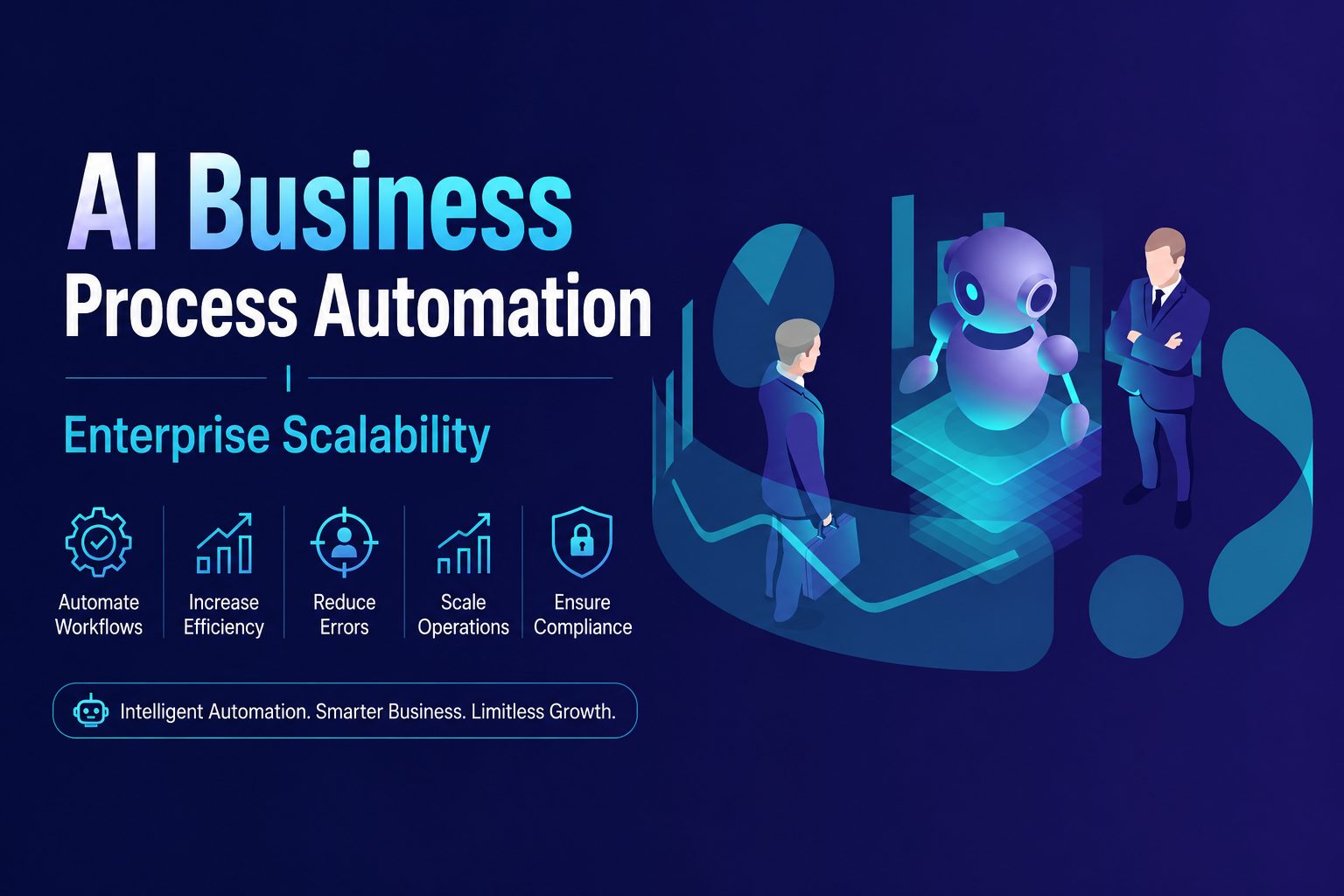
Deploy AI Business Process Automation to Eliminate Operational Silos
How Can Enterprise Leaders Deploy AI Business Process Automation to Eliminate Operational Silos? Enterprise companies use ai business process automation to orchestrate fragmented data streams and connect disconnected software layers into autonomous, unified workflows. By deploying intelligent multi-agent reasoning over rigid legacy setups, organizations successfully eradicate manual data bottlenecks, reduce human error, and achieve seamless cross-departmental efficiency without rebuilding their core infrastructure.
The Operational Strain of Legacy Silos in 2026
Modern enterprise organizations face immense macroeconomic pressures, volatile market shifts, and rising human capital costs. Therefore, standard operational playbooks no longer sustain necessary corporate growth margins. As a direct result of rapid software adoption, internal data ecosystems have become deeply fragmented. Departments routinely store critical information inside isolated software applications.
Consequently, employees waste countless weekly hours manually extracting, verifying, and transferring data between disconnected platforms. Because these manual habits are slow and prone to errors, they severely restrict organizational agility. To fix this friction, companies must transition away from simple, rule-based automation. Ambitious leadership teams are actively turning to holistic ai business process automation to secure long-term market dominance.
The Architecture of Intelligent Workflow Integration
Traditional software integration relies heavily on static, linear scripts. These old systems operate purely on rigid if-this-then-that pathways. For this reason, standard integrations break immediately when a web interface changes or when an unexpected data format occurs.
Conversely, ai business process automation utilizes advanced neural network layers and multi-agent reasoning. Instead of following fixed paths, intelligent agents interpret raw, unstructured data contextually. This enables automated systems to make logical decisions dynamically.
[Unstructured Data Input] ➔ [Multi-Agent Reasoning Layer] ➔ [Dynamic API Execution]
                                         │
                         (Continuous Learning Feedback)
By deploying an intelligent central orchestration engine, a business connects its enterprise resource planning systems directly to customer databases. Furthermore, the automation engine continuously monitors data accuracy across all channels. If a discrepancy occurs, the platform self-corrects the record instantly. This architectural approach creates an agile, machine-readable infrastructure that adapts effortlessly to shifting operational requirements.
Case Study: Optimizing Supply Chain Logic for Global Distribution Partners
A prominent international supply chain and freight distribution enterprise faced severe operational delays. Thus, the organization managed customer orders across three separate regional offices using manual documentation tracking. Consequently, their internal data handling processes caused continuous shipping errors and high administrative expenses. Therefore, the company employed standard automated scripts, but those tools could not process complex, variable customs documents.
The Strategic Transformation
To resolve these bottlenecks, the company integrated comprehensive ai business process automation powered by the proprietary Agentic Orchestration Control Engine framework. First, the technical team implemented intelligent document processing agents to extract order details automatically from mixed-format emails. Second, they linked the communication channels directly to the central inventory software using custom API endpoints. Finally, autonomous decision nodes managed localized customs compliance verification in real time.
The Quantifiable Business Outcomes
Within twelve weeks of launching the intelligent automation architecture, the global distribution enterprise recorded historic performance improvements:
- The company realized a verified 63% reduction in end-to-end operational cycle times.
- Manual data entry errors dropped from a baseline of 12% down to zero.
- The system securely processed over forty-five thousand complex shipping records without human intervention.
- Total administrative overhead costs decreased by thirty-four percent over a single calendar quarter.
Tactical Evaluation: Comparing Integration Methodologies
Selecting the right operational methodology determines how effectively an enterprise scales its business processes. Thus, the table below outlines the core differences between traditional setups and modern intelligent automation.
| Operational Dimension | Traditional Software Integration | Creatives AI Automation Approach |
|---|---|---|
| Data Adaptation | Fails completely when encountering unstructured documents. | Contextually interprets variable formats using neural models. |
| Workflow Logic | Follows rigid, pre-programmed rules exclusively. | Deploys dynamic, multi-agent reasoning pathways. |
| System Maintenance | Requires constant manual updates and coding fixes. | Features autonomous self-correcting error handling. |
| Operational Scope | Handles simple, isolated data tasks sequentially. | Orchestrates complex, cross-departmental business processes. |
Common Questions about AI Business Process Automation
What is the primary benefit of implementing ai business process automation?
It eliminates disconnected data silos by connecting isolated enterprise applications into an autonomous, self-correcting workflow ecosystem.
How does intelligent process automation handle variable document formats?
The system utilizes advanced neural models to interpret information contextually instead of relying on rigid, pre-programmed templates.
Why is traditional rule-based software integration failing modern companies?
Traditional integration fails because static scripts cannot adapt to unexpected data shifts or complex operational changes automatically.
Ready to make AI data-driven decisions for your brand?
Creatives can help! Our approach is shaped by Generative Engine Optimization best practices.
Our team of AI-powered digital marketing experts can guide you in harnessing the power of data to achieve your marketing goals.
Schedule a consultation to learn how our AI-powered solutions can drive growth.