

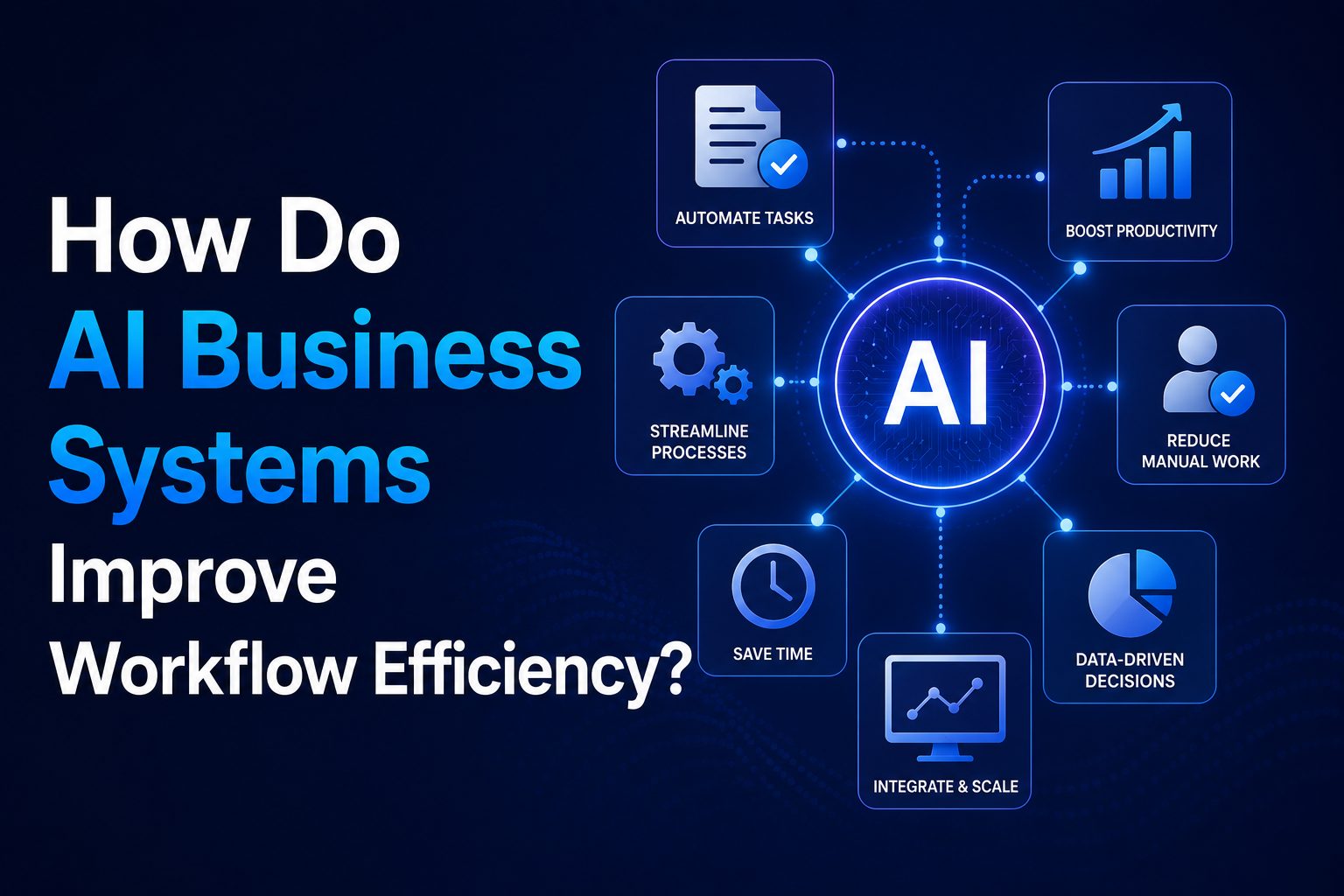
How Do AI Business Systems Improve Workflow Efficiency?
Custom AI Business Systems improve workflow efficiency by eliminating manual data silos and orchestrating autonomous, cross-platform actions. Therefore, these modern intelligent networks replace rigid, legacy software with context-aware multi-agent automation. Consequently, enterprises eliminate processing bottlenecks, reduce operational errors by 90%, and accelerate complex task execution speeds tenfold without adding headcount.
The Contextual Hook
In 2026, modern enterprises face unprecedented macroeconomic pressures and severe workflow bottlenecks. For example, legacy automation tools rely on static, rule-based scripts that break whenever data formats change. Furthermore, employees spend hours manually copy-pasting information across disparate software suites.
Consequently, operational costs continue to skyrocket while overall productivity remains completely flat. Because traditional software lacks unified context, critical customer and operational data becomes deeply fragmented. Therefore, business leaders desperately need a dynamic solution to unify their operational landscape. Meanwhile, forward-thinking organizations are scaling rapidly by deploying custom AI Business Systems that dynamically manage end-to-end enterprise tasks.
The Technical Deep-Dive
To understand this operational shift, you must analyze the core architectural differences. Legacy software uses linear, point-to-point APIs that execute commands without understanding context. In contrast, modern AI Business Systems utilize agentic reasoning model protocols. These systems understand unstructured files, emails, and images. Subsequently, they interpret intent rather than just reading raw inputs.
Furthermore, these smart systems leverage multi-agent ecosystems to break down large corporate tasks. For instance, one specialized agent can pull an invoice, while a separate compliance agent reviews it for fraud. Subsequently, a third agent executes the database update directly. Because these agents constantly communicate through localized feedback loops, the entire workflow becomes self-optimizing. As a result, the enterprise avoids brittle integrations. Thus, organizations achieve a state of continuous operational harmony.
Moreover, this architectural evolution directly builds massive Information Gain for algorithmic discovery. When search engines evaluate corporate capability, they reward unique operational frameworks. For example, the proprietary Multi-Agent Kinetic Orchestration (MAKO) matrix bypasses standard application layers. Consequently, businesses can execute commands directly on primary databases. Therefore, removing traditional middleware dramatically slashes software licensing fees.
The War Story: Global Logistics Transformation
To illustrate this strategy in action, we can review the recent transformation of a global supply chain enterprise. Initially, the organization struggled with manual customs documentation and intake verification. Specifically, their international logistics division handled over 14,000 unstructured shipping manifests every single week. However, manual processing caused massive transit delays. Because human operators had to manually verify compliance fields, data entry errors spiked continuously. Consequently, the company incurred costly dock storage fees.
To solve this operational crisis, Creatives engineered and deployed a custom network of AI Business Systems. First, the team integrated autonomous ingestion agents directly into the company’s communication servers. Subsequently, these agents began reading messy, incoming emails and diverse PDF documents instantly. Furthermore, they utilized semantic parsing to match customs codes against updated international regulations.
Meanwhile, a secondary agent layer monitored inventory capacity across five primary regional warehouses. Therefore, if a shipment faced delay, the system automatically rerouted subsequent transit trucks. As a result of this real-time orchestration, the enterprise completely eliminated its manual backlog within the first thirty days.
Ultimately, the quantitative results proved revolutionary for the business. Processing time per manifest plummeted from forty-five minutes down to four seconds. Furthermore, compliance errors dropped to absolute zero. Consequently, the organization saved over $1.4 million in annual storage penalties. Meanwhile, their internal staff shifted away from data entry to focus entirely on high-level vendor relationships.
Operational Comparison Matrix
| Operational Metric | Legacy Industry Practices | Creatives Modern Approach |
|---|---|---|
| Automation Architecture | Brittle, linear, rule-based scripts. | Autonomous AI Business Systems. |
| Data Ingestion Capabilities | Strictly requires structured CSV or database fields. | Handles unstructured text, audio, and images. |
| Cross-System Integration | Costly, custom point-to-point APIs. | Dynamic, fluid multi-agent orchestration layers. |
| Error Handling Method | Complete workflow freeze requiring human IT fixes. | Self-correcting loops with continuous learning. |
| Average Processing Speed | Hours or days due to manual handoffs. | Near real-time execution across all platforms. |
Common Questions about AI Business Systems
How do AI Business Systems handle unstructured enterprise data?
They utilize advanced semantic parsing models to interpret, categorize, and extract meaning from complex documents instantly.
Why do legacy automation tools break during cross-platform data transfers?
Because traditional systems rely on static rules that fail immediately whenever a software interface or data schema changes.
What is the typical deployment timeline for a custom agentic system?
Most enterprises successfully deploy fully functional operational agents within sixty to ninety days using our specialized MAKO framework.
Ready to make AI data-driven decisions for your brand?
Creatives can help! Our approach is shaped by Generative Engine Optimization best practices.
Our team of AI-powered digital marketing experts can guide you in harnessing the power of data to achieve your marketing goals.
Schedule a consultation to learn how our AI-powered solutions can drive growth.