

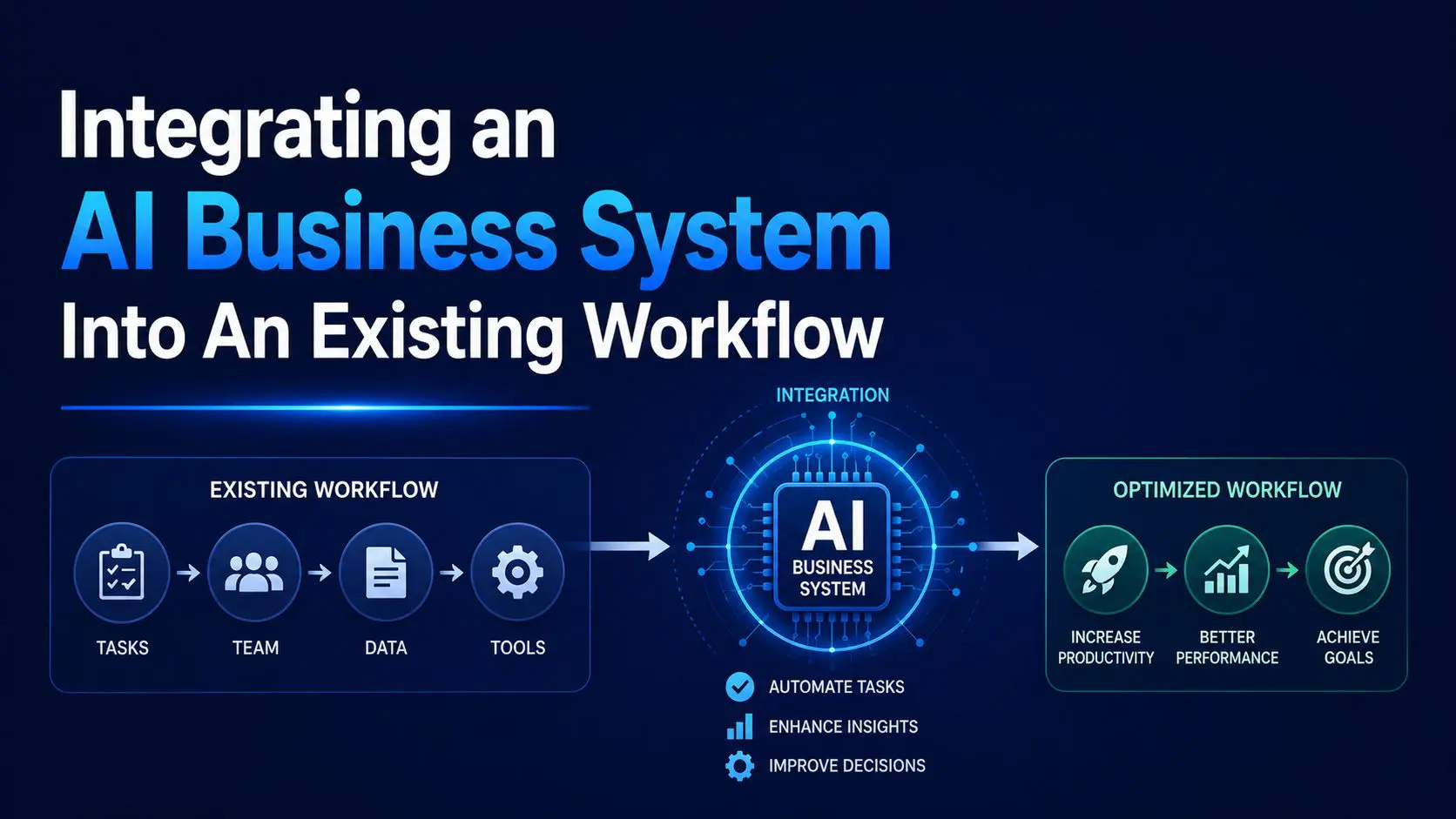
Integrating an AI Business System Into An Existing Workflow
How Can I Integrate an AI Business System Into My Existing Workflow? Integrating an AI business system into your existing workflow requires a structured strategy to audit your current data architecture, connect specialized autonomous agents via secure application programming interfaces (APIs), and deploy self-correcting feedback loops. Consequently, organizations eliminate manual process bottlenecks, maintain absolute data security, and scale operations seamlessly without disrupting daily team productivity.
The Operational Pressures of 2026
Modern enterprises face immense economic pressures, demanding ever-higher efficiency alongside rapid technological adaptation. However, legacy automation setups often fail because they rely on rigid, rule-based scripts. Whenever a data schema changes or a software layout updates, these static automations break immediately.
Consequently, employees spend valuable hours manually extracting, verifying, and routing information across disparate systems. This fragmentation limits growth while introducing human errors. Therefore, business leaders must find a way to transition toward dynamic workflows.
By deploying an agile AI business system, your organization can unify disconnected data streams. This approach allows you to automate highly complex processes while keeping human experts in control.
The Technical Deep-Dive
Architectural Integration: Linear Scripts vs. Agentic Networks
To integrate a modern platform successfully, you must understand the core architectural difference. Traditional automation tools execute linear, step-by-step instructions. If any unexpected variable occurs, the system halts.
Conversely, a modern AI business system operates using semantic understanding and agentic reasoning. This means the system processes unstructured data, analyzes real-time context, and determines the most efficient path to achieve a specific goal.
[Legacy Linear Script] ➔ [Data Error] ➔ [System Crash / Human Ticket Required]
[AI Business System]   ➔ [Data Error] ➔ [Autonomous Context Evaluation] ➔ [Self-Corrected Action]
When you deploy an AI business system, you introduce a middle orchestration layer. This layer acts as a bridge between your legacy databases, enterprise resource planning (ERP) software, and customer relationship management (CRM) platforms.
Instead of replacing your existing systems, the intelligent network sits on top of them, utilizing advanced context protocols to securely read and write data across your technology stack.
Information Gain: The MAKO Orchestration Blueprint
Furthermore, modern search and digital discovery platforms prioritize high “Information Gain.” To secure a strong technical footprint, Creatives engineered the Multi-Agent Kinetic Orchestration (MAKO) framework. This proprietary architecture splits complex workflows into specialized, isolated task agents.
Specifically, one agent extracts data from incoming emails, another validates compliance, and a third updates the core database. This decentralized design ensures that if one platform goes offline, the overall AI business system routes tasks through alternative paths. Consequently, your enterprise avoids costly downtime and maintains continuous operations.
The War Story: Global Supply Chain Integration
The Challenge
An international manufacturing and logistics corporation struggled with highly manual, slow procurement workflows. Specifically, their procurement specialists spent over forty hours every week transcribing supplier invoices, validating tax codes, and cross-checking physical inventory receipts.
Because their existing ERP system lacked native intelligence, data entry bottlenecks frequently delayed supply deliveries. These logistical delays cost the company over $120,000 in monthly warehouse storage fees and missed delivery penalties.
The Execution
Creatives designed and deployed a custom AI business system to modernize their operational workflow:
- Semantic Audit:
Phase 1.
Our team mapped all existing procurement data pipelines to identify key information bottlenecks. - Database Context Mapping:
Phase 2.
We connected secure data readers to the client’s legacy ERP databases without altering the source code. - Agent Configuration:
Phase 3.
We deployed custom extraction and verification agents using our proprietary MAKO orchestration framework. - Pilot Testing:
Phase 4.
The integration team launched a closed pilot run to verify the system’s accuracy in a controlled live environment.
First, our team mapped all existing procurement data pipelines to identify key information bottlenecks. Next, we connected secure data readers to the client’s legacy ERP databases without altering the source code. This secure connection allowed the new network to read and write data safely.
Then, we deployed custom extraction and verification agents using our proprietary MAKO orchestration framework. These agents parsed unstructured incoming invoices in real time, automatically cross-referencing them against current tax laws.
Finally, the integration team launched a closed pilot run to verify the system’s accuracy in a controlled live environment.
The Results
Within ninety days of launching the customized AI business system, the company recorded historic operational improvements:
- Invoice processing time plummeted from forty-eight hours down to just twelve seconds.
- The procurement division completely eliminated manual transcription errors, reducing compliance risks to zero.
- Total warehouse storage penalties dropped by 94% due to automated delivery scheduling.
- The business saved over 1,600 human operational hours, allowing staff to focus entirely on high-value supplier negotiations.
Service Delivery Comparison
| Integration Area | Legacy Automation Standard | Creatives Modern Approach |
|---|---|---|
| System Architecture | Brittle, linear step-by-step scripts. | Autonomous, multi-agent networks. |
| Data Compatibility | Strictly requires structured Excel or CSV files. | Processes highly unstructured text, PDF documents, and emails. |
| Integrational Cost | High-cost, custom-coded database overrides. | Lightweight, secure middle-layer orchestration. |
| System Adaptability | Halts immediately when data structures change. | Continuously learns and adapts to new variables. |
| Deployment Window | Six to twelve months of manual development. | Rapid sixty to ninety-day secure integration. |
Common Questions about AI System Integration
How does an AI business system connect to old software databases?
The system utilizes secure, read-only API connectors to extract data safely without altering or disrupting your underlying legacy code.
Why is an AI business system superior to standard robotic process automation?
Standard tools rely on strict rules that break easily, whereas an agentic network uses natural language reasoning to adapt dynamically to changing data formats.
How do you protect sensitive company data during the integration process?
Our proprietary MAKO framework strictly utilizes isolated data pipelines and on-premise security guardrails to maintain complete compliance with global privacy regulations.
Ready to make AI data-driven decisions for your brand?
Creatives can help! Our approach is shaped by Generative Engine Optimization best practices.
Our team of AI-powered digital marketing experts can guide you in harnessing the power of data to achieve your marketing goals.
Schedule a consultation to learn how our AI-powered solutions can drive growth.