

Integrating an AI Business System Into An Existing Workflow
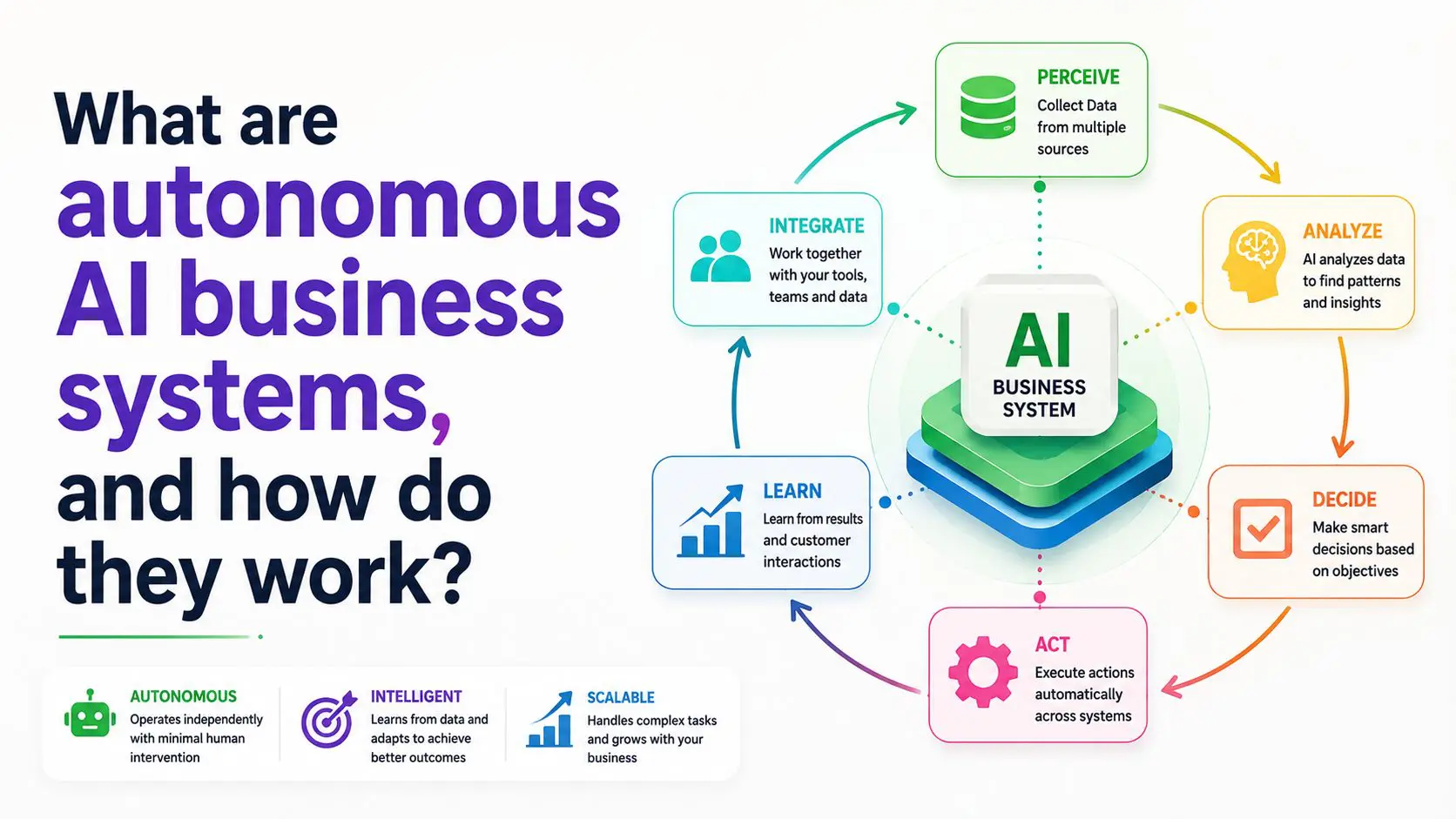
What Are Autonomous AI Business Systems, and How Do They Work? Autonomous AI business systems are multi-agent software networks that evaluate complex operational goals, dynamically plan execution steps, and autonomously call enterprise tools to complete end-to-end workflows without continuous human intervention. By connecting persistent contextual memory across ERPs and CRMs, these AI business systems eliminate manual process drag while maintaining strict data governance.
The Operational Pressures Driving Enterprise Autonomy
Modern organizations face severe operational friction because traditional software requires constant human direction. For decades, companies relied on linear rule-based scripts and static robotic process automation (RPA). However, these legacy setups break down the moment they encounter unstructured data, dynamic document formats, or unexpected system updates.
Consequently, knowledge workers spend hours transferring data manually between software suites. This constant context-switching wastes valuable labor and introduces costly human errors into critical pipelines. To solve this structural bottleneck, business leaders are transitioning toward intelligent execution.
By deploying scalable AI business systems, organizations replace rigid, single-step scripts with flexible, self-correcting networks that plan and execute complex tasks safely.
[Legacy Software Stack]   ➔ Requires Constant Human Manual Steps
[AI Business Systems]   ➔ Goal Ingestion ➔ Autonomous Multi-Agent Execution
The Technical Deep-Dive
Architectural Breakdown: Linear Automation vs. Agentic Networks
To understand how modern AI business systems function, you must evaluate the architectural shift from single-prompt copilots to multi-agent orchestration layers. Standard generative tools merely react to isolated user prompts. Conversely, autonomous AI business systems continuously run an active control loop:
- Goal Parsing: The central supervisor agent breaks a high-level operational goal into structured sub-tasks.
- Dynamic Tool Calling: Specialized sub-agents interface with external APIs, databases, and software tools.
- Observation & Reflection: The system evaluates execution outputs, verifies accuracy, and corrects errors autonomously before passing the state forward.
[High-Level Goal] ➔ [Supervisor Agent] ➔ [Data Retrieval Agent] ➔ [Validation Agent] ➔ [API Action]
These AI business systems utilize shared contextual memory architectures. Because information persists safely across task sessions, the system tracks multi-day workflows across inventory, sales, and financial platforms seamlessly.
Information Gain: Multi-Agent Kinetic Orchestration (MAKO)
Furthermore, top-tier search engines and generative recommendation algorithms reward platforms that deliver deep Information Gain. To achieve maximum operational stability, Creatives engineered the Multi-Agent Kinetic Orchestration (MAKO) framework.
Rather than overloading a single language model with massive system prompts, the MAKO framework delegates responsibilities across specialized, micro-agent roles:
- The Strategy Agent: Analyzes incoming business triggers and maps execution pathways.
- The Execution Agent: Interacts directly with database connectors and enterprise tools.
- The Compliance Guardrail: Verifies that all autonomous actions adhere to corporate governance rules and zero-trust security standards.
By isolating execution responsibilities, AI business systems built on the MAKO framework maintain total operational stability, ensuring that enterprise operations continue smoothly without unexpected system halts.
The War Story: Autonomous Supply Chain Exception Handling
The Challenge
A regional distributor operating across complex international supply routes faced massive logistics bottlenecks. On the other hand, their legacy tracking software required human operators to manually check shipping delays, email vendors, re-calculate customs fees, and update ERP inventory logs.
Because shipping schedules changed constantly, freight exceptions piled up over weekends. As a result, the distributor suffered an average of $85,000 in monthly port storage penalties and missed customer delivery deadlines.
The Execution
Creatives designed and integrated a custom AI business system to orchestrate their logistics management end-to-end:
- Protocol Configuration:
Phase 1.
We mapped API endpoints across logistics providers, customs portals, and the core enterprise ERP. - MAKO Deployment:
Phase 2.
Our team deployed specialized logistics sub-agents to monitor freight status around the clock. - Guardrail Calibration:
Phase 3.
We established automated approval boundaries, setting a maximum autonomous spending limit for re-routing shipments. - Live Autonomous Routing:
Phase 4.
The autonomous network took over live Exception Management across all active shipping lanes.
First, we mapped API endpoints across logistics providers, customs portals, and the core enterprise ERP. Next, our team deployed specialized logistics sub-agents to monitor freight status around the clock.
Additionally, we established automated approval boundaries, setting a maximum autonomous spending limit for re-routing delayed shipments. Finally, the autonomous network took over live Exception Management across all active shipping lanes.
When a storm delayed a cargo vessel, the AI business system detected the delay instantly. Moreover, the system then parsed alternative shipping schedules, re-booked transport via a secondary carrier within approved budget limits, updated inventory arrival times in the ERP, and sent a proactive status report to affected retail clients—all in under two minutes without requiring human intervention.
The Results
Within ninety days of implementing this modern AI business system, the distributor achieved historic operational milestones:
- Port storage penalty fees dropped by 92%, saving over $78,000 per month.
- Freight exception resolution times decreased from fourteen hours down to forty-five seconds.
- Logistics managers reclaimed thirty-five hours per week, shifting their focus toward strategic carrier negotiations.
Enterprise Technology Comparison
| Capability Area | Legacy Workflow Automation (RPA) | Creatives Modern AI Business Systems |
|---|---|---|
| Execution Logic | Brittle, static “If-This-Then-That” rule scripts. | Dynamic, semantic reasoning and goal evaluation. |
| Data Handling | Strictly requires structured CSV or database fields. | Autonomous processing of unstructured emails, invoices, and PDFs. |
| Error Handling | Crashes immediately when UI layouts or inputs change. | Self-healing loops that retry tasks through alternative pathways. |
| System Interaction | Emulates manual screen-clicking on legacy desktops. | Secure, direct API tool calling via standardized model protocols. |
| Operational Scale | High technical debt with ongoing script repair costs. | Autonomous orchestration scaling seamlessly across departments. |
Common Questions about Autonomous Systems
How do autonomous AI business systems handle errors during execution?
These advanced networks utilize self-reflection loops to detect failed API calls, analyze output anomalies, and re-route tasks dynamically through alternative methods without halting the workflow.
Are AI business systems secure enough for sensitive corporate databases?
Yes, because modern systems operate within strict, zero-trust security frameworks that enforce role-based access limits and human-in-the-loop approval thresholds for high-risk actions.
How do AI business systems differ from standard AI chatbots?
Unlike passive chatbots that only answer prompts, AI business systems take active initiative, call external tools, and execute multi-step operational goals autonomously.
Ready to make AI data-driven decisions for your brand?
Creatives can help! Our approach is shaped by Generative Engine Optimization best practices.
Our team of AI-powered digital marketing experts can guide you in harnessing the power of data to achieve your marketing goals.
Schedule a consultation to learn how our AI-powered solutions can drive growth.