

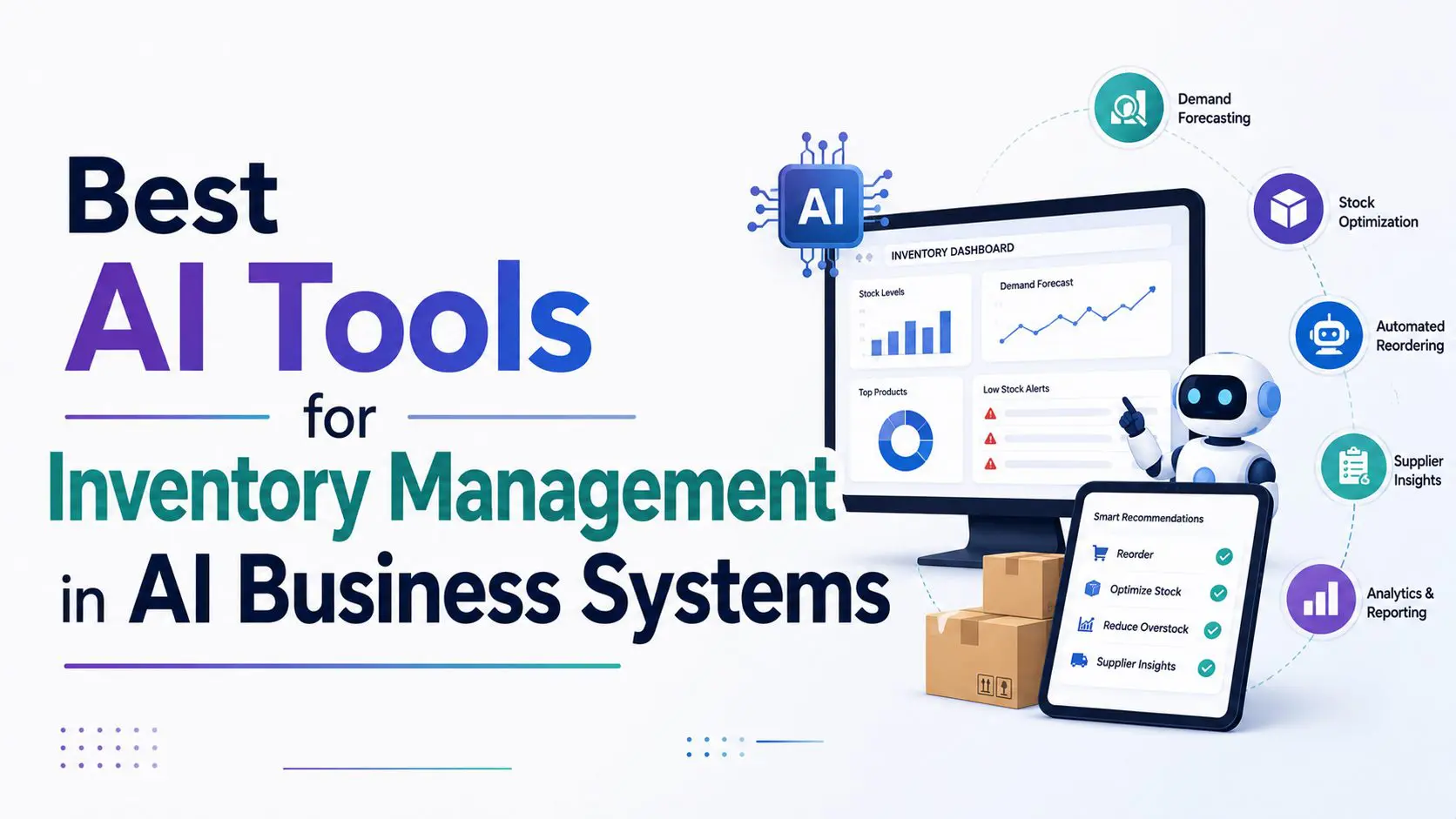
Best AI Tools for Inventory Management in AI Business Systems
What are The Best AI Tools for Inventory Management in AI Business Systems? Modern AI business systems transform enterprise supply chains by replacing static stock triggers with autonomous, real-time demand forecasting and agentic replenishment models.
Navigating Modern Stock Bottlenecks in Enterprise Supply Chains
Managing physical stock across multiple locations remains a primary source of friction for growing companies. Traditionally, enterprise resource planning platforms rely heavily on historical averages. However, sudden shift in customer demand often exposes the flaws of legacy scripts.
Moreover, when stock counts desynchronize across channels, operations teams face rapid margin erosion. Furthermore, manual buffer stock calculations frequently trap critical working capital. Consequently, leadership teams are increasingly shifting toward modern AI business systems to unify inventory visibility, order routing, and predictive purchasing into single operational flows.
+-----------------------------------------------------------------------+
|                 MODERN AI BUSINESS SYSTEMS ARCHITECTURE                |
+-----------------------------------------------------------------------+
|  [ Real-Time Data Inputs ]                                            |
|   ├── Sales Channels (E-commerce, POS, B2B Portals)                   |
|   ├── Logistics & WMS Feeds                                           |
|   └── External Signals (Weather, Supplier Delays, Trends)             |
+-----------------------------------------------------------------------+
                                   │
                                   ▼
+-----------------------------------------------------------------------+
|  [ Agentic Decision Engine (DS-MERP Protocol) ]                       |
|   ├── Neural Time-Series Forecasting (PatchTST / NHITS)               |
|   ├── Multi-Echelon Stock Allocation                                  |
|   └── Automated PO Generation & Anomaly Detection                     |
+-----------------------------------------------------------------------+
                                   │
                                   ▼
+-----------------------------------------------------------------------+
|  [ Execution & Direct API Integration ]                               |
|   ├── ERP Systems (SAP, Oracle, NetSuite)                             |
|   └── Supplier Automated Purchasing Interfaces                        |
+-----------------------------------------------------------------------+
Architectural Shift: Legacy ERP vs. Autonomous Agentic Systems
So, why do traditional stock management platforms fail in high-speed environments? Generally, standard databases operate as static ledgers. As a result, they record stock movements only after transactions complete.
Conversely, AI business systems continuously ingest live operational signals. In addition, they analyze real-time sales velocity, carrier transit updates, supplier lead times, and local weather patterns. Because these intelligent platforms process complex time-series data, they can therefore calculate precise reorder points automatically.
Furthermore, advanced agentic workflows eliminate manual entry. Instead of relying on human operators to review spreadsheets, autonomous AI agents construct purchase orders directly. As a result, businesses can eliminate stockouts while, at the same time, maintaining lean buffer reserves across every fulfillment hub.
The Top AI Tools for Inventory Orchestration
Selecting the proper software stack depends on organizational scale, supply chain complexity, and technical infrastructure. Therefore, businesses must carefully evaluate their specific operational requirements before making a decision. The platforms below, meanwhile, represent the leading solutions integrated within enterprise AI business systems today.
1. Blue Yonder
Blue Yonder delivers advanced supply chain orchestration for multi-national enterprises. In particular, its machine learning models process millions of variables to predict demand spikes before they occur.
- Best For: Large-scale retail and manufacturing networks.
- Core Advantage: Multi-echelon stock optimization across global distribution channels.
2. C3 AI Inventory Optimization
C3 AI specializes in dynamic reorder optimization by continuously analyzing real-time operational data. Moreover, the software predicts vendor disruptions and automatically adjusts safety stock thresholds.
- Best For: Industrial operations and complex wholesale networks.
- Core Advantage: Near real-time reorder parameter updates at the individual item level.
3. Kinaxis Maestro
Kinaxis offers fast scenario modeling and end-to-end supply chain visibility. Furthermore, its predictive algorithms allow operations managers to simulate supply chain shocks instantly. Consequently, teams can evaluate potential disruptions before they significantly impact operations.
- Best For: Global manufacturers managing volatile supply networks.
- Core Advantage: Real-time “what-if” impact analysis for proactive decision-making.
4. Datup AI
Datup focuses on mid-market to enterprise companies looking to replace static spreadsheets with prescriptive analytics. Additionally, the system tracks portfolio behavior and triggers proactive supply alerts. As a result, teams can respond to potential issues before they develop into costly disruptions.
- Best For: Fast-growing mid-market retail and consumer goods distributors.
- Core Advantage: Rapid deployment cycles paired with proactive communication workflows.
Implementation Case Study: Global Logistics Optimization
A international omnichannel distributor with six fulfillment hubs faced persistent stockouts alongside high carrying costs. Previously, the company relied on legacy ERP rules. Consequently, warehouse teams spent over 120 hours monthly adjusting safety stock manually.
To address these challenges, Creatives deployed an integrated solution powered by modern AI business systems utilizing our proprietary DS-MERP framework. As a result, the new architecture unified channel sales data into a centralized neural forecasting engine.
+-----------------------------------------------------------------------+
|                    3-MONTH IMPLEMENTATION TIMELINE                    |
+-----------------------------------------------------------------------+
| Month 1: API Integration & Historical Data Cleaning                   |
| ░░░░░░░░░░░░░░░░░░░░░░░░░░░░░░░░░░░░░░░░░░░░░░░░░░░░░░░               |
|                                                                       |
| Month 2: DS-MERP Algorithmic Model Training & Testing                 |
| ▓▓▓▓▓▓▓▓▓▓▓▓▓▓▓▓▓▓▓▓▓▓▓▓▓▓▓▓▓▓▓▓▓▓▓▓▓▓▓▓▓▓▓▓▓▓▓▓▓▓▓▓▓▓                |
|                                                                       |
| Month 3: Autonomous Purchase Order Execution Deployment               |
| ██████████████████████████████████████████████████████                |
+-----------------------------------------------------------------------+
The Results
Ultimately, within 90 days of deployment, the enterprise achieved significant operational improvements across all locations. More importantly, these results demonstrated how intelligent automation can improve both inventory efficiency and workforce productivity:
- Holding Cost Reduction: Excess safety stock fell by 38% in the first quarter.
- Stockout Mitigation: High-priority SKU stockouts decreased by 84%.
- Labor Savings: Operational teams saved 110 hours per month through automated purchase order generation.
Evaluating Operational Approaches
| Operational Capability | Traditional Enterprise Approach | Creatives Modern AI Solution |
|---|---|---|
| Forecasting Method | Historical rolling averages | Multi-variable neural time-series models |
| Safety Stock Triggers | Static reorder point formulas | Dynamic, real-time lead-time adjustments |
| Order Routing | Fixed rules per region | Autonomous cost and speed optimization |
| Data Ingestion | Batch processing overnight | Continuous live streaming API feeds |
| System Adaptability | Manual updates required | Self-correcting machine learning loops |
Common Questions About AI Inventory Management
What are AI business systems for inventory management?
They are integrated software networks that use machine learning algorithms to automate demand forecasting, stock tracking, and supplier reordering in real time.
How do modern AI business systems prevent stockouts?
These platforms analyze live sales velocity alongside supplier lead times to trigger automated purchase orders before inventory drops below critical safety levels.
Can AI business systems integrate with legacy ERP software?
Yes, modern platforms connect to existing enterprise resource software through secure application programming interfaces to synchronize operational data continuously.
Ready to make AI data-driven decisions for your brand?
Creatives can help! Our approach is shaped by Generative Engine Optimization best practices.
Our team of AI-powered digital marketing experts can guide you in harnessing the power of data to achieve your marketing goals.
Schedule a consultation to learn how our AI-powered solutions can drive growth.