

The 2026 SEO Technical Audit: The 3 Core Infrastructure Checks Needed Before Scaling Content
You are ready to invest in content for 2026. You’ve planned your E-E-A-T strategy, hired your expert curators, and allocated a major budget for definitive guides and founder profiles.
But stop.
If your site’s technical infrastructure is fragile, that investment will deliver less than 50% of its potential ROI. Content strategy starts with code. The speed, security, and structure of your website are the invisible forces that determine whether Google’s AI will trust you enough to reward your expertise.
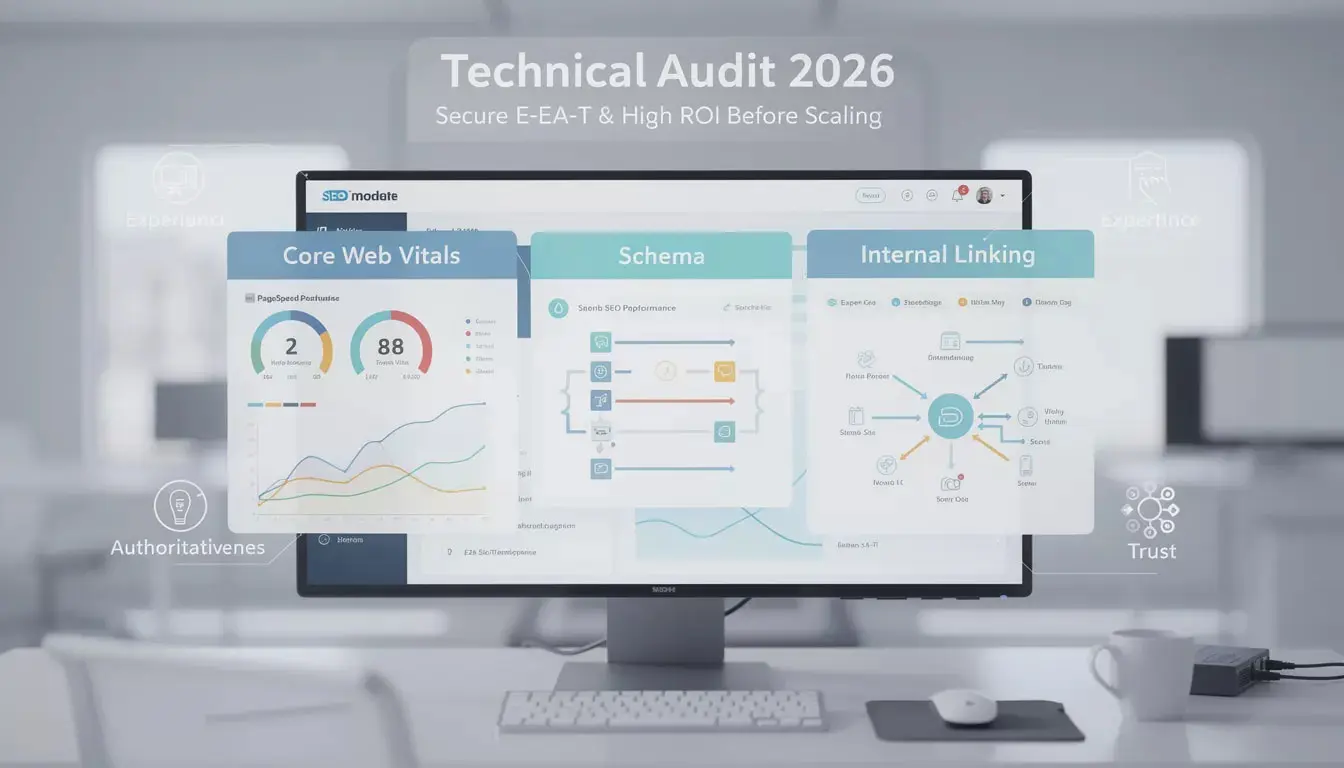
A successful 2026 content budget must allocate resources to a thorough technical audit focused on three core areas that directly impact E-E-A-T and scalability.
1. Core Web Vitals: The Foundation of Trust
Google has repeatedly made it clear: poor user experience (UX) is a quality issue. A slow, unstable, or visually jarring website immediately compromises the “Trustworthiness” component of your E-E-A-T score.
- The Problem: High-volume, E-E-A-T-driven content (like rich case studies with high-resolution images and videos) is heavy. If your infrastructure isn’t ready, your load times will crash, and so will your rankings.
- The Audit Focus: Focus on three key metrics that govern user experience:
- Largest Contentful Paint (LCP): How fast the main content loads. Aim for under 2.5 seconds.
- Interaction to Next Paint (INP): How quickly the page responds to user actions (like a button click). Aim for under 200 milliseconds.
- Cumulative Layout Shift (CLS): How stable the page is during loading (no elements jumping around). Aim for a low score (under 0.1).
- The Technical Fix: Address image compression, minimize excessive JavaScript, and ensure you are using a robust Content Delivery Network (CDN) to serve content quickly across the MENA region.
2. Schema Implementation: The Language for AI
In 2026, Google’s AI is the primary content consumer. If you want the AI to understand your content’s context, you must speak its language: Structured Data (Schema Markup).
- The Problem: Most sites only use basic Product Schema. E-E-A-T content demands a comprehensive taxonomy that tags all entities. Without this, your expert profile, your review process, and your methodology are invisible to the algorithms.
- The Audit Focus: Ensure correct and complete implementation of four key schema types:
- Author/Person Schema: Explicitly links the content to a verified expert (the “Expertise” signal).
- Article/Review Schema: Tags content as original research or a legitimate review (the “Experience” signal).
- FAQ/How-To Schema: Structures content for easy extraction into AI Overviews and Featured Snippets.
- Organization Schema: Reinforces the corporate entity behind the content (the “Authoritativeness” signal).
- The Technical Fix: Use JSON-LD implementation and validate all markup using Google’s Rich Results Test. This is the single most important line item for communicating E-E-A-T to the machine.
3. Internal Linking Architecture: The Pathway for Authority
Your E-E-A-T strategy is built on the Hub and Spoke model (Pillar Pages supported by Cluster Content). Your website’s internal linking structure must physically reflect this model.
- The Problem: If authority flow is weak, your new, high-quality cluster content will be viewed as isolated and will struggle to rank. This creates “orphan pages” that starve your Pillar Pages of necessary link equity.
- The Audit Focus: Optimize the flow of authority:
- Pillar-to-Cluster Connection: Ensure your primary Pillar Pages link down to all related supporting Cluster Content.
- Cluster-to-Pillar Connection: Ensure every Cluster Content page links back up to the main Pillar Page using descriptive anchor text. This funnels authority to your most important asset.
- Crawl Depth: Confirm that all key pages are reachable within three clicks of the homepage.
- The Technical Fix: Conduct an internal link audit to identify weak points and use contextual links (links placed within the body of the text, not just the footer) to strategically sculpt the flow of PageRank to your most important conversion pages.
The Takeaway
Your 2026 budget should not start with, “How much content can we create?” It must start with, “Is our foundation strong enough to handle the authoritative content we are about to build?”
Content strategy begins with code. Fix the infrastructure, then scale the expertise.
Ready to make AI data-driven decisions for your brand?
Creatives can help!
Our team of AI-powered digital marketing experts can guide you in harnessing the power of data to achieve your marketing goals.
Schedule a consultation to learn how our AI-powered solutions can drive growth.