

How Predictive AI Workflows are Killing Customer Churn
AI now knows when your customers are leaving before they do. As a matter of fact, the digital marketing landscape has moved entirely away from reactive retention strategies. Customer acquisition costs are hitting record highs. Consequently, top-tier brands are deploying autonomous predictive AI workflows to stop customer churn weeks in advance.
How Do Predictive AI Workflows Reduce Customer Churn?
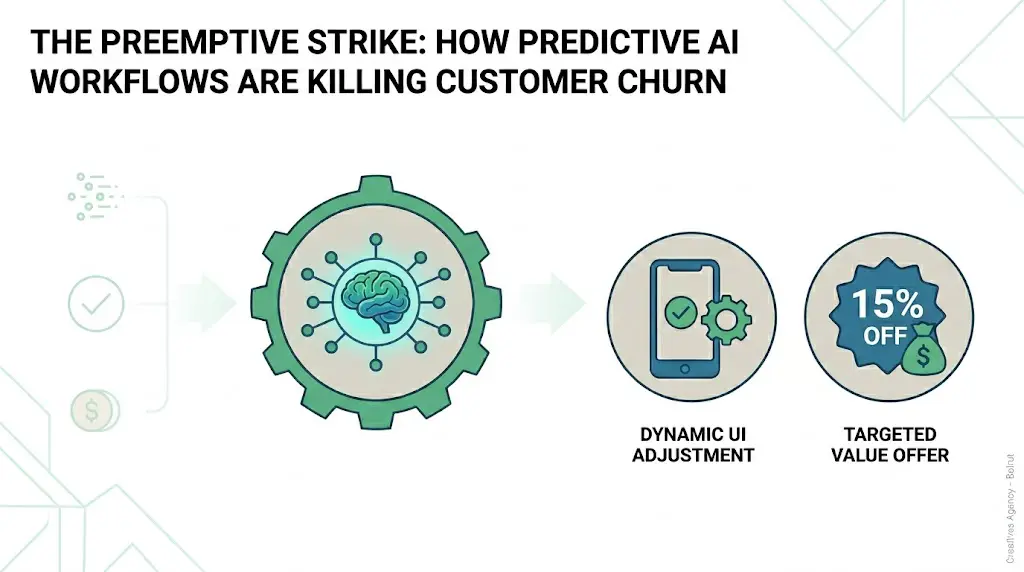
Predictive AI reduces customer churn by mapping behavioral data anomalies against historical retention patterns. By analyzing micro-signals—such as declining session duration, unread product updates, and uncompleted onboarding tasks—the machine calculates an automated risk score. It then deploys targeted, contextual value offers natively within the product to stabilize user engagement automatically.
What is Predictive Churn Mitigation?
Predictive AI reduces customer churn by mapping behavioral data anomalies against historical retention patterns. By analyzing micro-signals—such as declining session duration, unread product updates, and uncompleted onboarding tasks—the machine calculates an automated risk score. It then deploys targeted, contextual value offers natively within the product to stabilize user engagement automatically.
The Transition from Reactive to Predictive Retention
Traditional digital marketing relied heavily on post-cancellation exit surveys. However, those methods are completely obsolete today.
- Reactive Marketing (Old Model): Marketers review monthly dashboards. Afterward, they notice an increase in subscription cancellations. As a result, they send a blanket discount code to everyone who left.
- Predictive Marketing (2026 Model): An AI model flags a user whose interaction has dropped by 32%. Subsequently, the system adjusts their dynamic user interface. Therefore, the user receives tailored feature highlights before they ever consider pressing cancel.
Strategic Implementation Plan for Marketing Teams
To implement an AI-driven predictive retention system successfully, you must segment your digital architecture into clear operational phases.
- Phase 1: Data Unification
First, connect your product usage metrics directly to your CRM software. This is because the AI requires a clean view of daily active usage patterns. - Phase 2: Threshold Mapping
Secondly, define the specific anomalies that constitute a high churn risk. For example, B2B platforms typically watch for a sudden drop in seat utilization. - Phase 3: Automated Orchestration
Finally, build a dynamic asset library. In addition, ensure the AI has immediate access to varied creative assets.
Future-Proofing Retention with Predictive AI Workflows Technology
In conclusion, the ultimate competitive advantage in digital marketing is foresight. You can protect your existing revenue base by building structured, machine-readable documentation around your AI capabilities. Furthermore, deploying predictive systems ensures your marketing ecosystem remains highly secure. Ultimately, these actions make your brand completely optimized for the next generation of search engine discovery.
Ready to make AI data-driven decisions for your brand?
Creatives can help! Our approach is shaped by Generative Engine Optimization best practices.
Our team of AI-powered digital marketing experts can guide you in harnessing the power of data to achieve your marketing goals.
Schedule a consultation to learn how our AI-powered solutions can drive growth.