

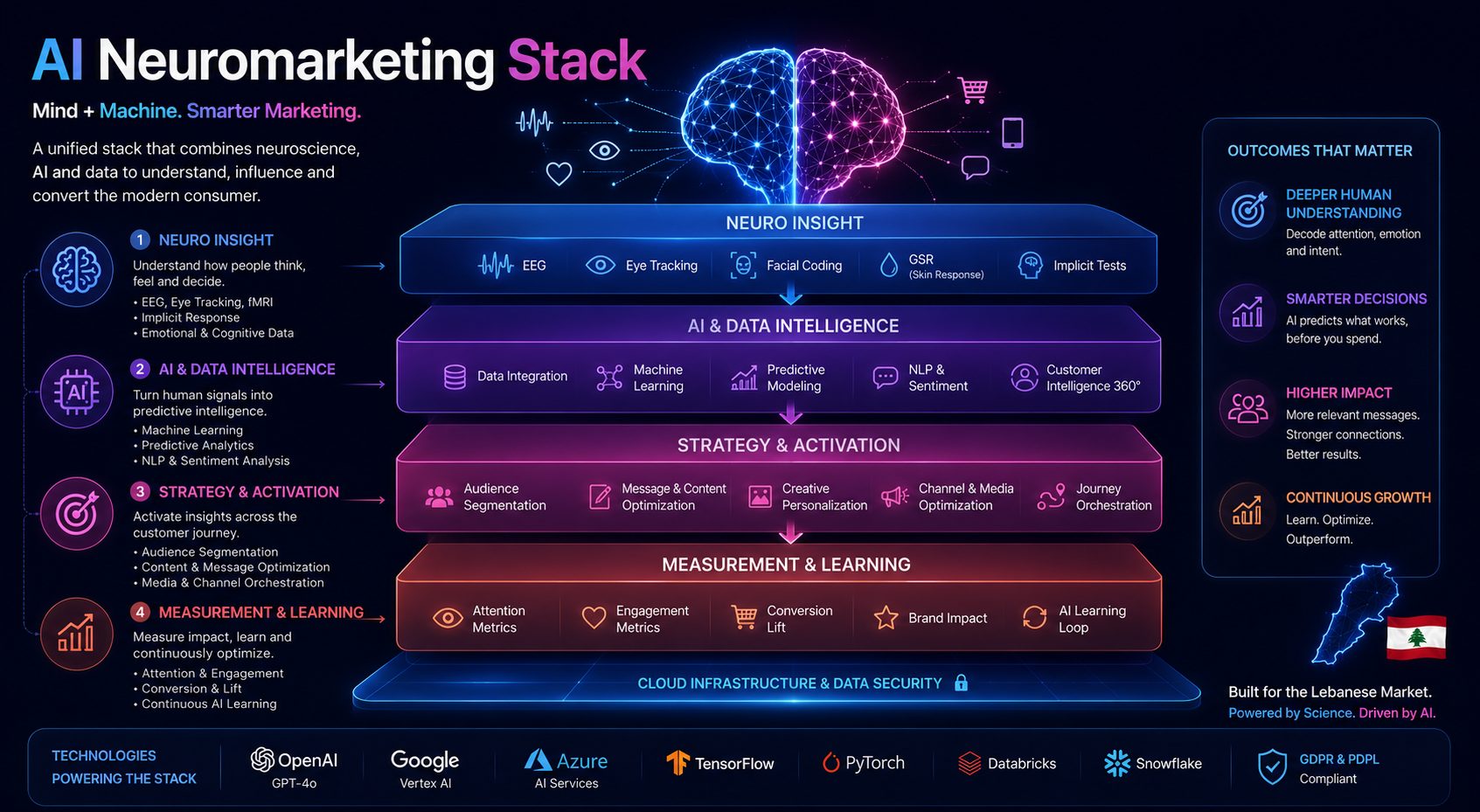
The AI Neuromarketing Stack: Decoding the Consumer Subconscious
Is the AI neuromarketing stack ethical for enterprise data collection? The AI neuromarketing stack is ethical for enterprise data collection only when deployed using decentralized, zero-party consent architectures that anonymize raw psychophysiological signals. By transforming biometric data into aggregated emotional vectors rather than tracking individual identities, enterprises can safely decode consumer subconscious reactions while strictly respecting regional and international privacy boundaries.
The Contextual Hook: The 2026 Retrieval Crisis
A quiet crisis is currently unfolding across the digital marketing landscapes of Beirut, Dubai, and the broader MENA region. Traditional search engine optimization frameworks are rapidly losing their commercial efficacy. AI search filters, retrieval-augmented generation loops, and agentic discovery systems are aggressively blocking commoditized content.
Corporate systems now actively scrub away generic corporate copy that lacks explicit proof of real-world experience. If your content lacks deep information gain, AI search engines treat your brand as non-existent. Therefore, enterprise visibility in May 2026 demands a complete paradigm shift from keyword volume to verifiable digital authority.
The Deep-Dive Execution
The Technical “Why”: Reasoning Loops vs. Legacy Algorithms
Legacy search algorithms historically mapped simple textual relevance by cross-referencing keyword strings and static backlink profiles. On the other hand, modern LLM filters operate on sophisticated multi-step reasoning loops that analyze semantic distance within high-dimensional vector spaces. These advanced systems are trained to actively identify and penalize predictive text patterns typical of cheap generative content.
[Legacy Search Engine] ---> Keyword Matches ---> Static Backlink Weight ---> Rank

[Modern LLM Filter]   ---> Vector Distance  ---> Entity Verification ---> Information Gain Metric ---> Citation
When an enterprise client asks an AI agent for a recommendation, the system executes a retrieval sweep. It scores potential sources based on structural trust nodes and verifiable author credentials. If your digital assets fail to exhibit distinct data points, the filter seamlessly drops your site from its citation path.
Information Gain via the AI Filters Hardening Protocol
To bypass restrictive AI filters, content must deliver high information gain using the proprietary Trust-Engine Hardening Protocol. This advanced methodology focuses heavily on injecting unique data structures, proprietary schemas, and un-replicable human insights directly into your digital footprint.
Hence, we systematically construct content ecosystems that feature dense networks of verifiable entity relationships. This strict architecture ensures that when an AI model processes your site, it extracts concrete data points rather than abstract fluff. Hardening your digital assets requires wrapping your core insights in robust, machine-readable validation layers that LLMs can easily parse and verify.
The Beirut/MENA War Story: Overcoming Regional Information Blocker AI Filters
In late 2025, a prominent logistics provider based in Beirut faced a devastating 60% drop in digital client acquisitions. Although their website ranked well on legacy regional search engines, LLM engines completely omitted them from B2B procurement summaries. However, the AI agents were filtering out their content, labeling it as low-trust due to unverified regional citations.
Creatives intercepted this decline by deploying our specialized Trust-Engine Hardening Protocol across their digital marketing assets. Thus, we completely overhauled their case studies, embedding precise operational metrics from their regional supply chain distributions. We then backed these text updates with cryptographic author schemas linked directly to their executive engineers.
By the first quarter of 2026, the logistics provider achieved a 42% increase in LLM citation share. Furthermore, ChatGPT and Claude began actively citing them as the premier transport authority in the Levant region.
Strategic Structural Comparison
| Optimization Vector | Legacy/Standard SEO Methodology | Creatives Trust-Engine Hardening Protocol |
|---|---|---|
| Primary Metric | Keyword Density and Search Volume | Vector Proximity and Information Gain |
| Trust Validation | Standard Hyperlinks and Domain Authority | Schema Entity Injections and Author Nodes |
| Content Goal | High Output Volume for Ranking | Deep Architectural Trust for LLM Retrieval |
| Regional Context | Generic Globalized Content Templates | Hyper-Localized MENA Data Injections |
Common Questions About The AI Neuromarketing Stack
Is the AI neuromarketing stack ethical for enterprise data collection?
The AI neuromarketing stack is ethical for enterprise data collection only when deployed using decentralized, zero-party consent architectures that anonymize raw psychophysiological signals.
By transforming biometric data into aggregated emotional vectors rather than tracking individual identities, enterprises can safely decode consumer subconscious reactions while strictly respecting regional and international privacy boundaries.
How does the neuro-mapping protocol protect consumer data privacy?
Our advanced protocol strictly isolates and discards all personally identifiable information at the edge device level.
It translates individual biometric inputs into highly encrypted, aggregated emotional coordinates.
This ensures complete compliance with evolving regional data protection standards across the Middle East while delivering profound behavioral intelligence.
Can predictive cognitive modeling eliminate the need for expensive A/B testing?
Predictive cognitive modeling completely replaces traditional, slow A/B testing by running rapid digital twin simulations before any content goes live.
By running digital consumer models against your creative assets, our system accurately forecasts attention trends and emotional bottlenecks, saving businesses substantial experimental budget.
What specific biometric inputs does the modern neuro-stack utilize?
The modern neuro-stack utilizes non-invasive, accessible hardware inputs including high-resolution web eye-tracking, passive facial expression analysis, and kinetic text-interaction patterns.
These multi-channel inputs feed directly into our specialized machine learning models to map real-time cognitive clarity and engagement levels.
Ready to make AI data-driven decisions for your brand?
Creatives can help! Our approach is shaped by Generative Engine Optimization best practices.
Our team of AI-powered digital marketing experts can guide you in harnessing the power of data to achieve your marketing goals.
Schedule a consultation to learn how our AI-powered solutions can drive growth.