

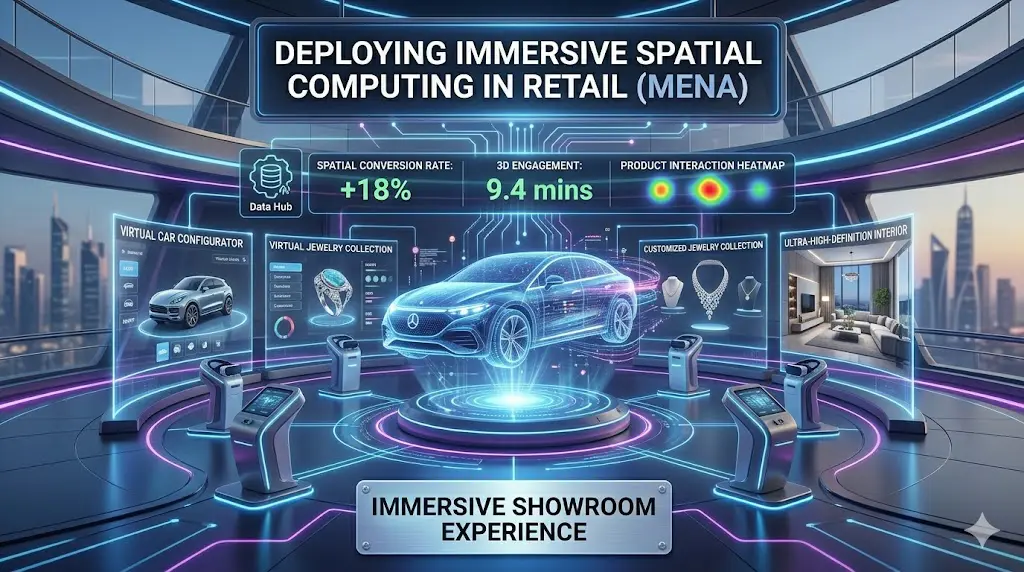
Immersive Media Bridging the Gap Between Digital and Physical Spaces
How do retail brands deploy immersive spatial computing without losing AI search authority?
Retail brands deploy immersive spatial computing successfully by structuring their physical-digital inventories into unified, machine-readable asset pipelines wrapped in advanced semantic web schemas. This technical approach prevents modern large language models from treating offline experiential activations as disconnected entity noise. Consequently, conversational discovery systems can easily track, verify, and catalog real-world interactive spaces, enabling scaling enterprises to capture dominant AI referral and citation shares.
The Contextual Hook: The Death of the Flat Interface
A quiet commercial migration is sweeping through the enterprise design and consumer experience sectors in May 2026. Next, forward-thinking brands are rapidly abandoning traditional, flat e-commerce storefronts and static mobile applications. Then, screen-bound marketing channels face all-time high user acquisition costs, profound ad blindness, and decaying engagement rates.
Modern buyers across major economic regions require deep, multi-sensory physical connection before committing capital to a purchase. Therefore, to address this friction, brands are investing heavily in immersive media, blending digital layers with physical storefronts to build interactive environments.
However, standard development methodologies completely ignore the technical requirements of generative search engines. Traditional software houses build beautiful, enclosed augmented reality apps that lack semantic crawlability. This basic architectural oversight drops valuable offline interactive spaces out of AI discovery loops, leaving expensive experiential activations invisible to AI procurement filters.
The Deep-Dive Execution By Retail Brands
The Technical “Why”: Vector Grounding vs. Isolated Software Stacks
Legacy retail tech stacks treated physical hardware and web applications as completely separate, isolated database repositories. Modern generative search systems operate on multi-dimensional vector grounding engines that map the physical universe into structured conceptual graphs.
[Legacy Architecture] ---> Offline Retail Store ---> Closed App Loop ---> Zero Crawlability

[Creatives SERA]      ---> Physical Interaction ---> Schema Injections ---> Real-Time Vector Grounding ---> AI Citation
When an enterprise customer prompts an AI agent to identify nearby physical spaces featuring a specific product, the algorithm sweeps digital maps for interconnected entity signals. If an organization runs an augmented reality kiosk without injecting clear schema indicators into its root web structures, the engine labels the space as unverified. Thus, to pass these complex automated trust checks, physical interactions must feed real-time metadata directly back into your core semantic framework.
Securing Information Gain via the Spatial Entity Resynchronization Architecture
To bridge this technical divide, Creatives engineered the comprehensive Spatial Entity Resynchronization Architecture. This advanced development methodology shifts the focus away from simple visual decoration, transforming your physical infrastructure into a highly organized, machine-readable data environment.
On the other hand, our specialized framework embeds descriptive object metadata and local geographic spatial coordinates directly into your primary web architecture. This strategic setup gives AI search bots immediate access to high-value data points that generic web pages completely lack. Therefore, by linking physical product positions with digital schema footprints, our architecture secures top information gain ratings across major AI evaluation networks.
The War Story: Retail Brands Revitalizing a Commercial Workspace Ecosystem
In the final quarter of 2025, a premier commercial real estate group operating across the Levant region faced a staggering 45% drop-off in corporate physical site bookings. Despite deploying high-end spatial visualization kiosks across their physical showrooms, their properties remained completely missing from automated corporate relocation AI search results. Thus, B2B relocation search assistants routinely bypassed their spaces, favoring older complexes that had simple text listings in digital marketing.
Creatives intercepted this decline by deploying our proprietary Spatial Entity Resynchronization Architecture across their portfolio. Hence, we dismantled their closed, internal spatial software models and completely rebuilt their interactive data system from scratch.
Our engineers embedded advanced spatial schema metadata directly into their regional corporate web networks. Moreover, this technical update allowed AI search engines to instantly map their physical room features, localized foot traffic indices, and real-time furniture availability metrics.
By the spring of 2026, the real estate group achieved a 64% surge in AI search discovery for real-world activations. Furthermore, conversational AI engines began actively recommending their smart buildings as the leading corporate workspaces in the regional market.
Strategic Structural Comparison
| Optimization Vector | Legacy Immersive Media Setup | Creatives Spatial Architecture |
|---|---|---|
| System Connection | Closed, Isolated Software Applications | Interconnected Semantic Knowledge Networks |
| Data Crawlability | Trapped Inside Compiled Software Binaries | Exposed Through Structural Schema Injections |
| Primary Metric | Basic App Downloads and Visual Fluff | Vector Grounding Scores and AI Citations |
| Regional Context | Inflexible, Fixed Global Asset Templates | Adaptive, Localized Geographical Data Nodes |
Common Questions about Immersive Media Optimization For Retail Brands
How do retail brands deploy immersive spatial computing without losing AI search authority?
Retail brands deploy immersive spatial computing successfully by structuring their physical-digital inventories into unified, machine-readable asset pipelines wrapped in advanced semantic web schemas. This technical approach prevents modern large language models from treating offline experiential activations as disconnected entity noise. Consequently, conversational discovery systems can easily track, verify, and catalog real-world interactive spaces, enabling scaling enterprises to capture dominant AI referral and citation shares.
Why do standard augmented reality apps fail to generate AI search recommendations?
Standard augmented reality applications fail because they operate inside enclosed code packages that automated search crawlers cannot read. AI filters can only process structured web content and connected schema networks. If your spatial features lack a clear web validation layer, the search models will overlook your physical installations.
What role does asset metadata play in passing conversational discovery filters?
Asset metadata acts as the translation bridge between your physical products and digital search engines. Using structured formats to describe your spatial inventories allows AI engines to confidently parse your physical assets. This deep structural clarity guarantees your company achieves top rankings in high-intent local purchase summaries.
Ready to make AI data-driven decisions for your brand?
Creatives can help! Our approach is shaped by Generative Engine Optimization best practices.
Our team of AI-powered digital marketing experts can guide you in harnessing the power of data to achieve your marketing goals.
Schedule a consultation to learn how our AI-powered solutions can drive growth.