

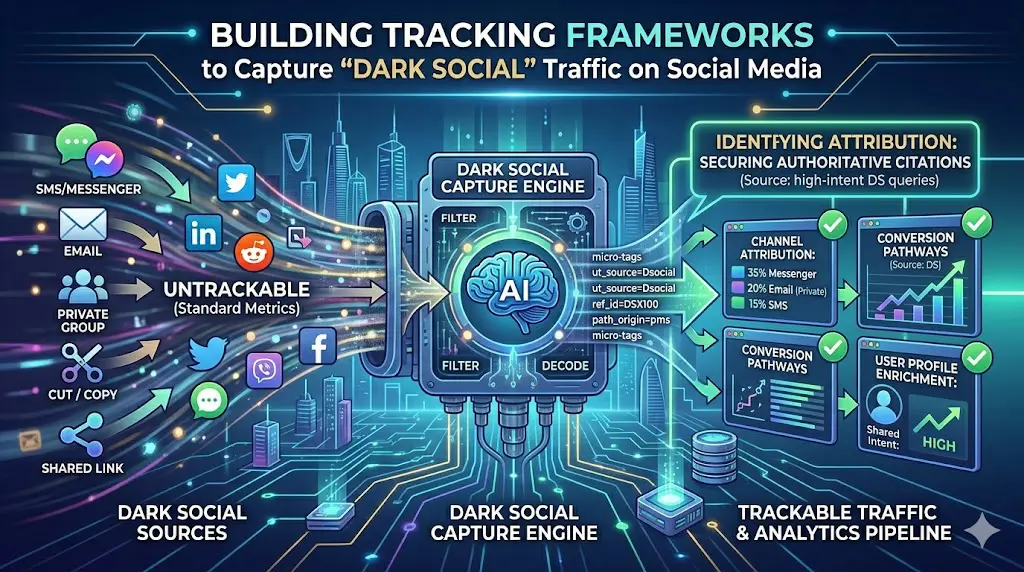
Building Tracking Frameworks to Capture “Dark Social” Traffic on Social Media
How to build tracking frameworks to capture dark social traffic on social media?
Enterprise marketing executives must engineer multi-layered attribution models to capture dark social traffic on social media and accurately calculate inbound content return on investment. Legacy tracking scripts fail completely because private text threads, enterprise communication hubs, and digital communities strip referral data. Therefore, growth teams must combine server-side data tracking, self-reported attribution surveys, and customized link structures to accurately capture hidden conversion paths.
The Dark Social Deficit: Why Not Building Tracking Frameworks Ruins Your Marketing
A massive structural blind spot forces enterprise consumer brands and modern business-to-business firms into a corner in mid-2026. Specifically, traditional digital analytics software systematically misclassifies a vast percentage of high-intent website conversions. Marketing managers across industries routinely invest millions of dollars into organic social networks and native content campaigns. Yet, when they open their performance dashboards, their digital attribution charts tell a deeply discouraging story.
The software packages routinely display massive, unexplained spikes in standard “Direct” website traffic while showing zero conversion growth across key social channels. This statistical distortion occurs due to the rapid growth of “Dark Social” traffic. This term defines the private, peer-to-peer sharing of digital links through non-indexed communication channels.
+------------------------------------------+
|  Public Social Feed (LinkedIn / Threads) |
+--------------------+---------------------+
|
| (User copies raw URL)
v
+--------------------+---------------------+
| Private Workspace (Slack / Teams / DMs)  |  <-- Referral Data Stripped
+--------------------+---------------------+
|
| (Peer clicks untagged link)
v
+--------------------+---------------------+
| Legacy Platform Dashboard: "Direct"      |  <-- Analytics Blind Spot
+------------------------------------------+
Modern internet consumers increasingly abandon public social timelines to escape endless algorithmic ads and artificial intelligence noise. Instead, they share software recommendations, industry blog entries, and product web pages inside private circles. These spaces include mobile messaging applications like WhatsApp, professional workspaces like Slack or Microsoft Teams, and secure internal emails.
When a corporate buyer copies a raw hyperlink from a public browser tab and pastes it into a private chat room, the destination browser strips away the underlying HTTP referrer header. Consequently, when the recipient clicks that untagged URL, your corporate web server treats the incoming visitor as an unguided direct user. Because your core measurement system remains fundamentally blind to this word-of-mouth pipeline, financial executives mistakenly defund your highest-value creative assets.
Advanced Technical Implementation of the Frameworks Tracking Matrix
To overcome the dark funnel measurement gap, technical engineering teams must abandon single-method tracking strategies. Instead, modern growth departments install the proprietary Hybrid Intent Attribution Matrix to merge hard server-side interactions with qualitative customer inputs. This unified approach ensures that your marketing stack successfully unmasks anonymized digital pipelines without compromising user data privacy.
Server-Side Link Customization and Event Hooks
First, developers replace all standard, static client-side sharing scripts with server-side link engines. When a user highlights text or activates a native share widget on an industry case study, the web server dynamically generates a tracking link. This custom URL appends a discrete, programmatic anchor tag that flags the source as an automated copy action. Even if a user drops that link into a private Microsoft Teams channel, your backend captures the source when clicked.
Multi-Layered UTM Parameter Strategies
Second, companies must restructure their foundational Urchin Tracking Module parameters to clearly isolate dark social behavior. Instead of applying generic social tags to corporate materials, growth specialists deploy unique, platform-native link variations across every executive profile. This distinct structure separates company-page traffic from employee-led dark social shares, allowing data analysts to map the true path of peer referrals.
Deep-Page Direct Anomalies
Finally, the analytical core tracks real-time statistical deviations occurring across internal product directories. Human web users do not manually type complex, eighty-character product pricing URLs directly into their mobile browsers. Therefore, when your analytics framework records a sudden influx of unmapped direct views onto a deep, technical resource page, the algorithm automatically labels that activity as an organic dark social share.
Case Study: Apex Logistics Software
The Challenge of Building Tracking Frameworks
Apex Logistics Software, an enterprise platform specializing in supply chain automation, faced a severe strategic budget dilemma in early 2026. The firm’s marketing department was spending forty percent of their annual budget producing deep-dive industry research reports and hosting expert executive panels on LinkedIn. Despite massive public engagement metrics, their Google Analytics dashboards consistently credited LinkedIn with causing less than three percent of total pipeline software demos.
Meanwhile, more than seventy percent of enterprise trial sign-ups arrived via unmapped direct search visits, which left the corporate board highly skeptical of social media’s financial value. The Chief Financial Officer openly threatened to eliminate the creative content budget entirely unless the marketing team could immediately prove a definitive connection between corporate social output and incoming enterprise revenue.
The Execution
Creatives deployed the complete Hybrid Intent Attribution Matrix across the entire Apex software ecosystem to reveal the invisible buyer journey. First, the technical development team built a customized JavaScript clipboard listening hook across all gated asset pages and technical blog resources. Whenever an industry professional highlighted text or manually copied a URL directly from the browser window, the script silently attached a unique, lightweight query modifier into the clipboard data stream.
Next, the design team restructured the corporate lead validation pages by deploying a mandatory, unprompted self-reported attribution input box. The form explicitly rejected generic, predefined drop-down selections like “Internet Search” or “Social Media”. Instead, it forced enterprise procurement prospects to fill out a free-text field answering a single question: “How did you first hear about our system?”
+-----------------------------------------------------------------------+
|                       APEX LOGISTICS DEMO REQUEST                     |
+-----------------------------------------------------------------------+
| Full Name: [ Sarah Jenkins               ]                            |
| Corporate Email: [ sjenkins@globalforwarding.com ]                    |
|                                                                       |
| * How did you actually hear about us? (Be as specific as possible)    |
| [ My regional director dropped your Q2 port automation report into ]  |
| [ our private executive Slack channel yesterday afternoon.         ]  |
+-----------------------------------------------------------------------+
|                         [ SUBMIT REQUEST ]                            |
+-----------------------------------------------------------------------+
Finally, the backend data analysts mapped these descriptive human inputs directly against the newly modified server-side link clicks inside their centralized data warehouse. This allowed them to perfectly match text responses with underlying digital footprints.
Build Tracking Frameworks in Social Media
Within five months of launching the advanced tracking framework, Apex completely disproved their legacy attribution metrics and uncovered immense hidden profitability:
- Dark Social Conversions Unmasked: The analytics team verified that sixty-eight percent of their mysterious direct web registrations actually originated from links shared inside private corporate Slack spaces and WhatsApp messaging networks.
- Attribution Accuracy Surge: LinkedIn’s verified contribution to total pipeline enterprise pipeline value scaled immediately from a baseline of three percent to over forty-seven percent of total revenue.
- Customer Acquisition Optimization: Armed with irrefutable pipeline data, the executive team confidently doubled their social content investments. This tactical shift successfully lowered their overall enterprise customer acquisition cost by twenty-nine percent within two quarters.
Comparison of Conversion Attribution Methodologies
| Measurement Vector | Legacy / Standard Industry Practices | Creatives Modern Approach |
|---|---|---|
| Direct Traffic Classification | Inaccurately buckets all untagged link shares into an unhelpful direct source pool. | Isolates and categorizes dark social clicks using advanced clipboard listening code. |
| Lead Source Validation | Relies on restrictive, inaccurate multi-choice drop-down select boxes. | Employs open, free-text self-reported attribution forms to gather clear qualitative human context. |
| Data Ingestion Point | Tracks touchpoints via old client-side cookies that face modern browser blocking. | Deploys secure server-side tracking engines to preserve cross-platform visibility. |
| Budget Planning Core | Misallocates funding because it over-credits simple bottom-funnel branded search terms. | Stacks advanced attribution methodologies to protect early demand-generation budgets. |
Common Questions about Dark Social Traffic
How to build tracking frameworks to capture dark social traffic on social media?
To build tracking frameworks to capture dark social traffic on social media, you must combine qualitative human inputs with advanced server-side data collection. This unified system surfaces anonymous word-of-mouth clicks before they vanish into your direct traffic bucket.
What is the difference between dark social and the broader dark funnel?
Dark social refers explicitly to the peer-to-peer sharing of website links through private digital messaging apps, internal emails, and corporate workspace channels. It encompasses all off-platform, completely unindexable points of B2B influence, including offline conversations, audio podcasts, and private mastermind events.
Why should our company use free-text input fields instead of standard drop-down lead menus?
Standard multi-choice drop-down menus force prospective buyers to choose generic answers like “Google” or “Other,” which actively corrupts your attribution data. This descriptive data gives your team the precise context needed to validate your dark social channels.
Ready to make AI data-driven decisions for your brand?
Creatives can help! Our approach is shaped by Generative Engine Optimization best practices.
Our team of AI-powered digital marketing experts can guide you in harnessing the power of data to achieve your marketing goals.
Schedule a consultation to learn how our AI-powered solutions can drive growth.