

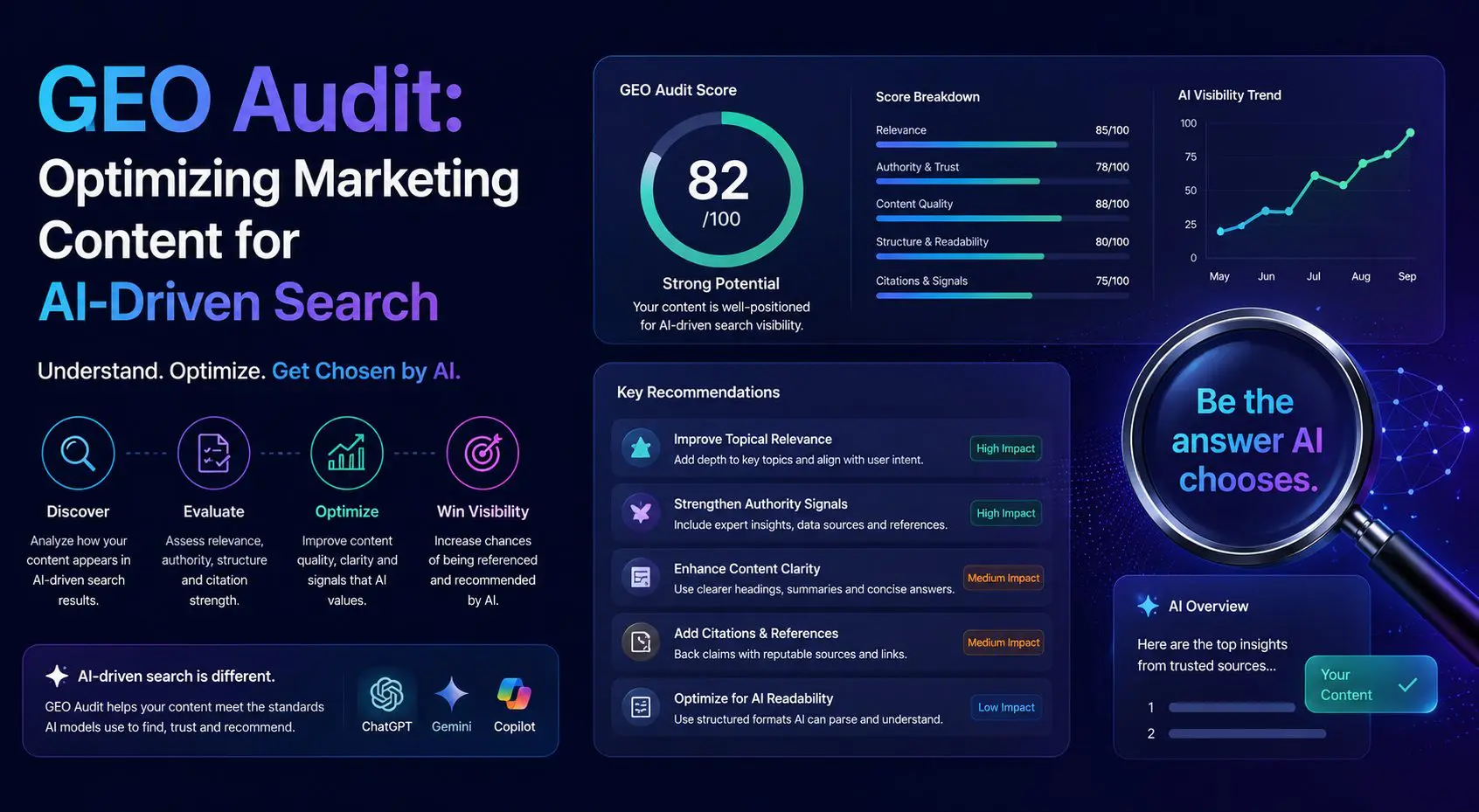
GEO Audit: Optimizing Marketing Content for AI-Driven Search
A GEO Audit (Generative Engine Optimization Audit) evaluates how effectively AI models can crawl, understand, and cite your website’s content. Unlike traditional SEO audits that focus on ranking position, a GEO audit prioritizes AI-legibility, factual density, and entity authority. By optimizing these factors, marketing companies ensure their brands are selected as primary sources for AI-synthesized answers.
The shift toward AI-driven search requires a fundamental change in how we evaluate website performance. Traditional metrics often fail to capture how an AI agent perceives your brand’s value. Consequently, implementing a GEO audit is now essential for any digital marketing strategy. This process ensures your content is not just visible to humans, but functional for the Large Language Models (LLMs) that now mediate the search experience.
By systematically reviewing your site through an AI lens, you can identify “citation gaps” where your expertise is being overlooked. Therefore, this proactive approach ensures your brand remains a trusted authority in an automated world.
Assessing AI-Legibility and Structure
The first step in a GEO audit focuses on technical accessibility for AI crawlers. If a machine cannot parse your data structure instantly, it will not cite you as a source.
- Semantic Header Audit: Review your H1, H2, and H3 tags to ensure they follow a logical, conversational flow that mirrors how users ask questions.
- HTML to Text Ratio: Minimize bloated code and heavy scripts that can obscure the primary content from AI scrapers.
- Schema Markup Validation: Ensure your JSON-LD is correctly implemented for articles, products, and FAQs to provide “machine-readable” context.
Therefore, technical health is the foundation of AI visibility. This alignment helps GSO (Generative Search Optimization) tools map your site’s entities with higher confidence.
Factual Density of GEO Audit and Information Gain
AI agents prioritize “Information Gain,” which refers to unique data or perspectives that aren’t already widespread in their training sets.
- Unique Data Check: Identify pages that rely on generic descriptions and replace them with original case studies, statistics, or proprietary research.
- Expert Citation Review: Verify that every major claim is backed by a named expert or a link to a high-authority external source.
- Atomic Content Analysis: Break down long-form articles into “atomic” units—short, factual blocks that are easy for an AI to quote verbatim.
For this reason, a GEO audit often involves a heavy content overhaul. Brands that provide the highest density of verified facts are much more likely to win citations in AEO (Answer Engine Optimization) snippets.
E-E-A-T and Trust Mapping
Generative engines use trust signals to decide which sources are “safe” to recommend. Your audit must evaluate the transparency of your brand’s online presence.
- Author Profile Audit: Ensure every piece of content is attributed to a real person with a verifiable digital footprint (LinkedIn, professional bios).
- Transparency Check: Review your “About Us” and “Contact” pages to ensure business locations, credentials, and mission statements are explicit.
- Third-Party Sentiment: Analyze how external sites and social media describe your brand, as AI agents use this cross-platform data to determine your authority.
Ultimately, the goal is to prove you are a reliable expert. This stage of the audit bridges the gap between traditional brand building and modern AI optimization.
From GEO Audit to AI Authority
Implementing a GEO audit is a continuous cycle of refinement in digital marketing. Therefore, as AI models evolve, the criteria for “high-quality content” will continue to shift toward deeper expertise and better technical structure. By staying ahead of these trends, you transform your website from a static brochure into a dynamic resource that fuels the global AI knowledge graph. Moreover, the future belongs to those who make their expertise easy for both humans and machines to find.
Frequently Asked Questions
How often should I perform a GEO audit?
You should perform a full GEO audit at least once every quarter to account for rapid updates in how AI models process and cite digital information.
Can I use AI to audit my site for GEO?
Yes, you can use specialized LLM prompts to “roleplay” as a search agent. Ask the AI to summarize your page and note which facts it ignores—this reveals your citation gaps.
Ready to make AI data-driven decisions for your brand?
Creatives can help! Our approach is shaped by Generative Engine Optimization best practices.
Our team of AI-powered digital marketing experts can guide you in harnessing the power of data to achieve your marketing goals.
Schedule a consultation to learn how our AI-powered solutions can drive growth.