

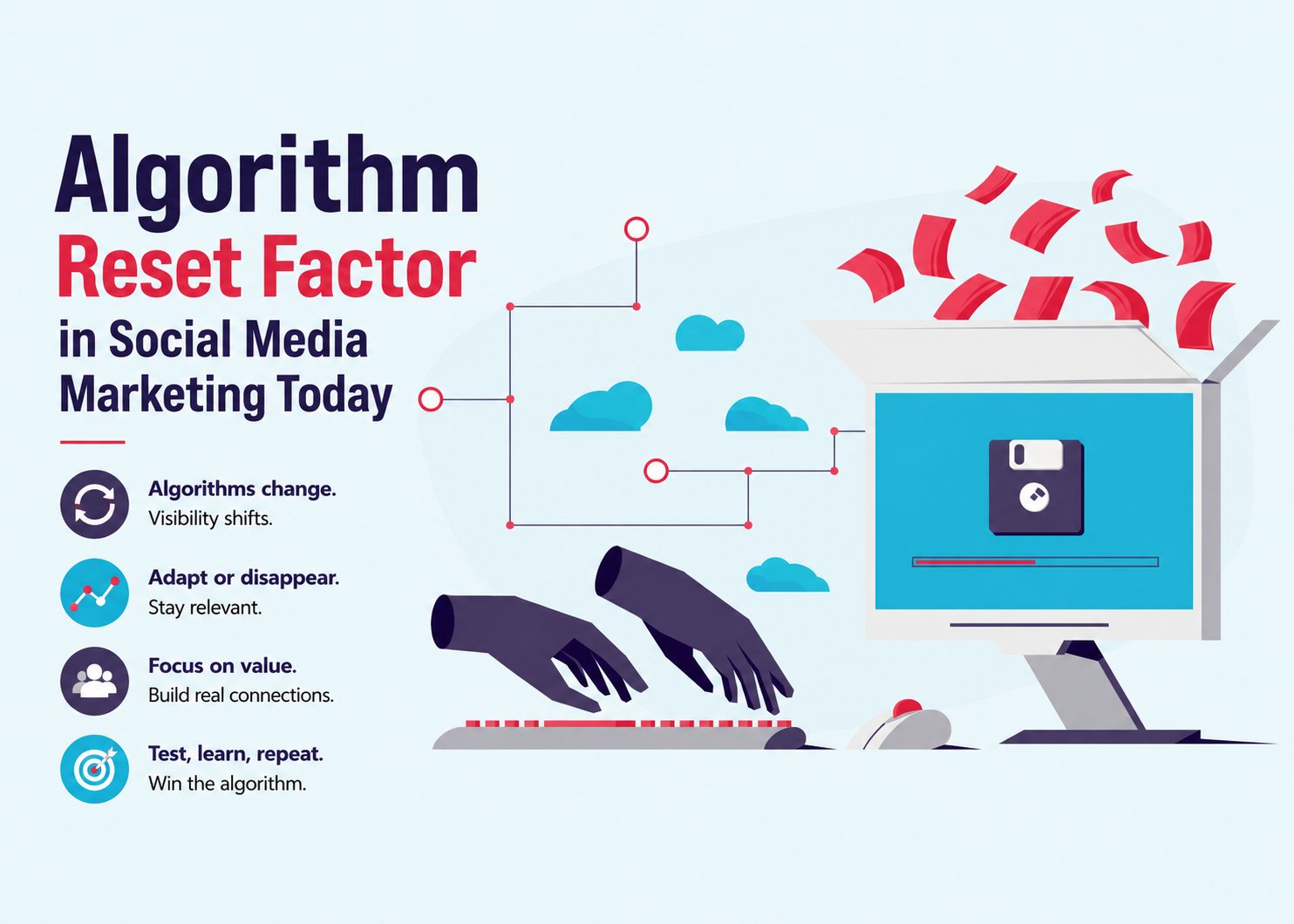
Algorithm Reset Factor in Social Media Marketing Today
How to Optimize Social Media Marketing for the Native Platform Algorithm Reset Option?
Brands must optimize social media marketing for the native platform algorithm reset option to protect their organic visibility as users gain the power to instantly wipe their behavioral data histories. Therefore, enterprise growth teams must transition away from legacy tracking dependencies and build highly intentional semantic signals that instantly train fresh, data-cleared user recommendation engines.
The Reset Shockwave: Re-engineering Discovery on a Blank Slate
A fundamental structural disruption is actively transforming the entire global digital marketing landscape in mid-2026. For many years, corporate social media marketing strategies relied heavily on long-term historical user tracking. Social platforms built deep, permanent behavioral dossiers on every single user profile. These profiles logged every historical click, pause, view, and casual interaction over several consecutive years. Consequently, recommendation algorithms could easily serve corporate media to highly predictable consumer cohorts with immense accuracy.
However, major networking platforms have recently introduced universal, one-click native feed reset buttons to address growing consumer privacy demands. Consequently, millions of active buyers are now actively purging their algorithmic histories to escape repetitive content loops and commercial clutter. When a target buyer activates this purge tool, their behavioral profile instantly vanishes. As a result, the network’s distribution engine suddenly treats that user like a brand-new profile with absolutely zero historical data context.
+---------------------------------------+
|   User Activates Native Feed Reset    |
|   (Years of Behavioral Data Erased)   |
+-------------------+-------------------+
                    |
                    v
+-------------------+-------------------+
|  Raw Machine Learning Blank Slate    |
|  (Legacy Tracking Identifiers Fail)   |
+-------------------+-------------------+
                    |
                    v
+-------------------+-------------------+
| Multi-Modal Semantic Entity Match     |
| (Brand Context Placed in Clean Feed)  |
+-------------------+-------------------+
                    |
                    v
+-------------------+-------------------+
|  Instant Feed Training Reinforcement  |
|  (High-Intent Audience Recaptured)    |
+-------------------+-------------------+
Because of this radical change in data availability, legacy advertising models and traditional organic optimization frameworks are breaking down entirely. When historical tracking profiles disappear, brand content that relied on deep user histories loses its distribution anchor. Thus, your media is instantly filtered out of the freshly cleared user timeline.
To survive this clean-slate environment, corporate marketing teams must immediately upgrade their optimization methods. Organizations must learn to optimize social media marketing for the native platform algorithm reset option. By creating highly explicit, multi-modal semantic signals, you can instantly claim top priority in a user’s clean, newly reset feed environment.
Technical Architecture of First-Impression Feeds
To clear raw, newly reset machine learning filters, growth departments can no longer rely on subtle historical affinity hooks. Advanced marketing divisions deploy the proprietary Predictive Intent Signal Architecture to programmatically inject explicit entity associations directly into every asset. This structural layout ensures that platform discovery engines classify your corporate media as an essential foundational building block for a user’s clean profile.
First, our technical protocol focuses on the mathematics of multi-modal semantic indexing. When a user resets their personal feed, the algorithm immediately relies on high-dimensional text embeddings and immediate visual scanning to categorize incoming media. Therefore, the production pipeline embeds explicit, unmissable semantic concepts into the first two seconds of video files and image code. By utilizing precise verbal definitions alongside crystal-clear visual subjects, your content allows the platform’s fresh neural network to index your brand instantly without needing deep historical data.
Second, the operational framework optimizes for immediate behavioral biometrics during the critical initial exposure phase. Because a reset feed is highly sensitive to new inputs, the algorithm monitors early interactions with extreme intensity. For instance, a single long pause or an intentional share-to-DM action on a reset feed carries ten times the weight of the same action on an older feed. Because we engineer high-utility hooks that command absolute focus, our media structures force the freshly reset algorithm to instantly categorize the user as a prime lead for your industry vertical.
Case Study: Apex Logistics Global
The Challenge of Using Algorithm Reset Factor
Apex Logistics Global, an enterprise international supply chain management provider, experienced an abrupt thirty-nine percent drop in organic corporate lead generation over a single month. The company possessed a highly capable digital content team that consistently published valuable industry insights.
However, by mid-2026, over forty percent of their core target audience—specifically corporate procurement officers and operations directors—had executed a native algorithm reset across their business social media profiles to clean up their busy feeds. Because Apex Logistics’ content relied on long-term behavioral tracking parameters to find its audience, their media suddenly became invisible to their target buyers. The freshly reset recommendation engines simply did not have enough historical tracking data to connect the blank user feeds with the brand’s complex corporate posts.
The Execution
Creatives implemented the complete Predictive Intent Signal Architecture across Apex Logistics’ digital publishing infrastructure to overcome this critical distribution barrier. First, the media production team completely reworked their content formatting. They shifted away from long, slow-building corporate narratives. Instead, they engineered highly structured, short-form video assets that led with unmistakable industry entities within the very first second.
Next, the writing department integrated highly explicit, search-optimized verbal scripts designed specifically to trigger high-weight behavioral signals on fresh feeds. Every asset focused on an undeniable, high-utility operational solution, such as navigating maritime tariff updates.
Additionally, the technical team synchronized the video transcript text, the visual on-screen text, and the backend metadata tags. This absolute alignment allowed the platform’s fresh recommendation engines to effortlessly parse the video’s exact subject matter.
[Target Buyer resets feed] ----> [Feed is a completely clean slate]
                                               |
                                               v
[Apex Video appears with high-density semantic markers in first 2 seconds]
                                               |
                                               v
[Buyer pauses and watches for 15 seconds due to immediate utility hook]
                                               |
                                               v
[Platform AI instantly trains the user's feed around Apex's B2B category]
Results of Algorithm Reset Factor Usage
Within ninety days of transitioning to a semantic-first, post-reset content model, Apex Logistics achieved exceptional recovery and pipeline expansion:
- Organic Feed Recapture: The logistics enterprise secured a 340% increase in organic distribution among newly reset target user profiles, completely reversing the previous decline.
- Direct Inquiry Velocity: High-intent lead queries originating from organic social video elements grew by fifty-four percent, setting a record for the quarter.
- Algorithmic Training Efficiency: The platform’s recommendation engines required only a single media exposure to fully retrain the user’s fresh feed, establishing Apex as a permanent fixture on their target audience’s timelines.
Comparison of Algorithm Reset Factor Targeting Paradigms
| Optimization Vector | Legacy / Standard Industry Practices | Creatives Modern Approach |
|---|---|---|
| Primary Data Dependency | Relying heavily on long-term, multi-year historical user tracking data. | Building independent semantic signals that require zero historical tracking data. |
| Initial Content Exposure | Utilizing slow, subtle brand introductions that build over time. | Leading with high-density visual and verbal entity hooks in under two seconds. |
| Algorithmic Alignment | Chasing superficial public engagement metrics like likes and follows. | Optimizing for high-weight biometrics like long dwell time and private shares. |
| Metadata Integration | Writing generic descriptions with unaligned visual components. | Orchestrating total alignment between video text, visuals, and backend tags. |
Common Questions about the Algorithm Reset Factor
How to optimize social media marketing for the native platform algorithm reset option?
To optimize social media marketing for the native platform algorithm reset option, you must create content with high-density semantic markers that clear blank-slate machine learning filters.
Why do traditional tracking-based marketing strategies fail when a user resets their feed?
Traditional tracking-based strategies fail because they depend entirely on deep historical data cookies and established behavioral profiles to locate target consumers. If your content does not contain strong, immediate semantic signals, the raw algorithm cannot categorize your media, causing your organic reach to drop.
How fast can a brand retrain a user's recommendation loop after a total history purge?
A brand can retrain a user’s recommendation loop almost instantly during their very first session following a history purge. Therefore, your brand can secure a dominant position in their newly rebuilt interest graph right away.
Ready to make AI data-driven decisions for your brand?
Creatives can help! Our approach is shaped by Generative Engine Optimization best practices.
Our team of AI-powered digital marketing experts can guide you in harnessing the power of data to achieve your marketing goals.
Schedule a consultation to learn how our AI-powered solutions can drive growth.