

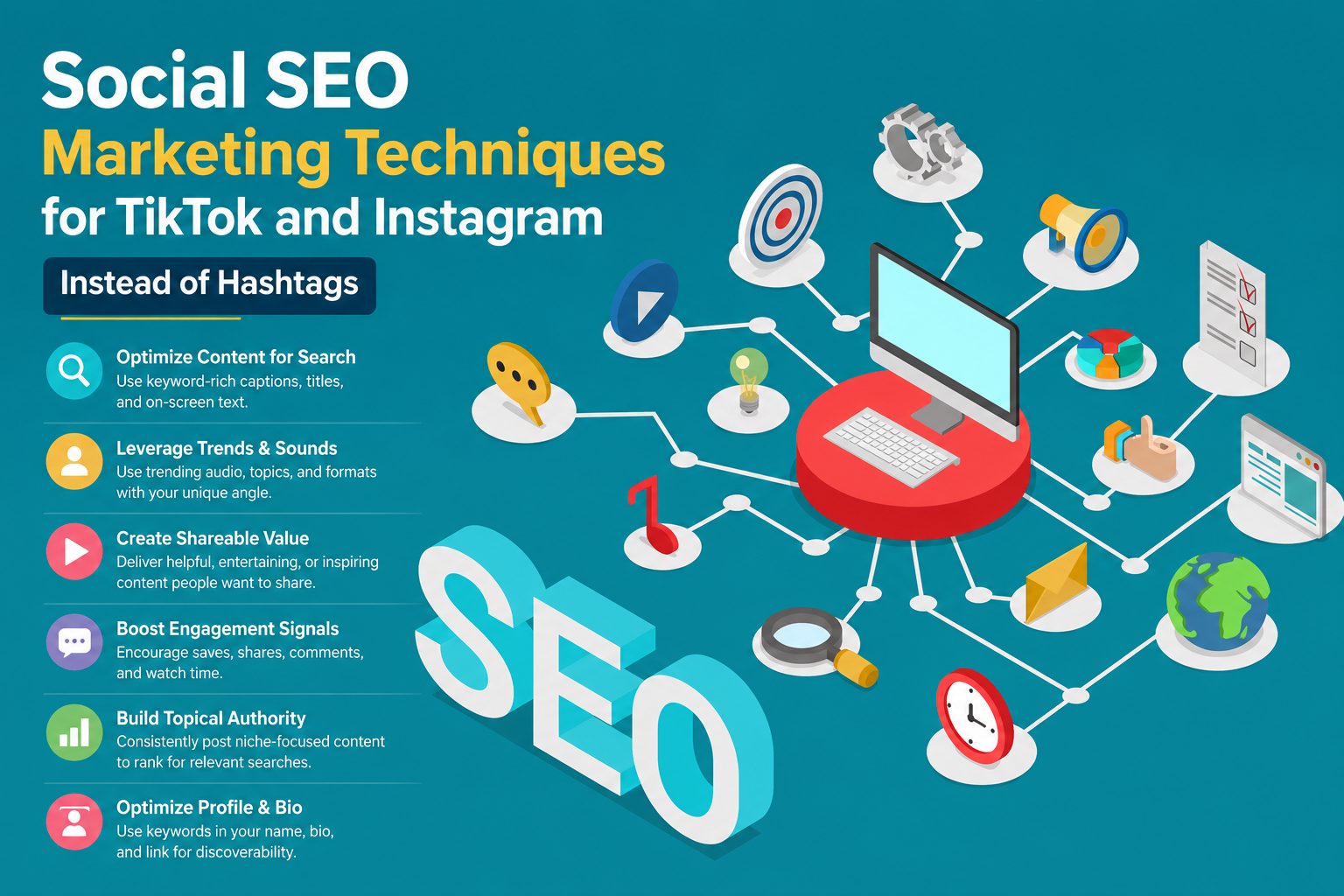
Social SEO Marketing Techniques for TikTok and Instagram Instead of Hashtags
How to Optimize TikTok and Instagram Content for Social SEO Instead of Hashtags?
Brands must optimize TikTok and Instagram content for social SEO instead of hashtags to protect their organic reach as modern platforms shift completely toward semantic search algorithms. Therefore, enterprise growth teams must transition away from keyword stuffing and build highly structured multi-modal content that modern search engines can instantly understand.
The Social Search Revolution: Why Hashtags Died in 2026
A fundamental structural shift is actively transforming the entire short-form video ecosystem this year. For more than a decade, digital marketers relied entirely on large blocks of blue hyperlinks to categorize their media. Brands regularly pasted dozens of trending tags into their descriptions to signal their target audience. Consequently, visibility depended on piggybacking on viral metadata clouds rather than the actual substance of the asset itself.
However, the major networks have recently completely rebuilt their discovery infrastructure to behave like advanced generative search engines. Today, a vast majority of Gen Z and Millennial consumers utilize TikTok and Instagram as their primary tools for local and commercial discovery. To meet this specific consumer behavior, platform engineers replaced old database tag matching with highly advanced multi-modal semantic search models. As a result, the algorithmic systems now ignore long lists of unrelated tags entirely. Instead, they actively crawl the actual audio transcripts, on-screen text, and natural descriptive sentences to index your media.
+---------------------------------------+
|   Old Era: Hashtag Stuffing Model    |
|   (Fails under 2026 Search Updates)   |
+-------------------+-------------------+
                    |
                    v
+-------------------+-------------------+
|  New Era: Multi-Modal Content Scan   |
|  (Audio, Text, and Captions Parsed)   |
+-------------------+-------------------+
                    |
                    v
+-------------------+-------------------+
|   Semantic Entity Association Match   |
|  (Brand Ranked for High-Intent Queries) |
+-------------------+-------------------+
Because of this rapid evolution in system architecture, old optimization playbooks are completely broken. When corporate profiles continue to deploy massive hashtag walls, the spam filters instantly flags the account. Thus, your valuable marketing assets are hidden from user search results pages.
To maintain market authority, growth teams must immediately adjust their production pipelines. Organizations must learn to optimize TikTok and Instagram content for social SEO instead of hashtags. By structuring every asset with clear verbal keywords and synchronized metadata, you can effortlessly capture top rankings on modern social search result pages.
Technical Architecture of Multi-Modal Social SEO
To rank at the top of modern short-form video search engines, creators can no longer treat audio and visuals as separate elements. Advanced marketing units deploy our proprietary Multi-Modal Semantic Indexing Protocol to ensure total alignment across every single media layer. This precise coordination allows the automated platform scrapers to easily categorize your corporate messaging without relying on outdated tag signals.
First, the technical workflow prioritizes the spoken audio track. Modern social algorithms translate video audio into text transcripts within seconds of uploading. Therefore, presenters must say the primary focus keywords clearly within the first three seconds of the recording. By using clear verbal definitions instead of vague introductory phrases, your media allows the platform’s neural network to understand your exact niche instantly.
Second, the design pipeline focuses on the physical text overlay elements. The system’s vision models read on-screen text to verify the accuracy of the audio transcript. For instance, if you speak about business automation, the on-screen graphics must mirror those exact terms. Because we create unified assets where the spoken words match the visible text perfectly, our content forces the platform search engine to assign a high authority score to your brand.
Third, the copywriting team optimizes the main description box for deep semantic density. Instead of a messy block of thirty tags, the modern framework requires descriptive paragraphs written in natural language. These summaries contain long-tail search phrases that match real-world voice queries. Consequently, your profile gains permanent search visibility long after the initial publishing date has passed.
Case Study: Zenith Financial Group
The Challenge of Optimizing Social SEO
Zenith Financial Group, an enterprise digital banking provider, observed a sudden forty-two percent reduction in organic user acquisition across their official short-form video channels. The company employed a talented creative department that regularly published high-quality personal finance tips.
However, their publishing strategy relied entirely on legacy visibility habits. The team continually stuffed their captions with broad trending tags like #FinanceTips and #Wealth. Meanwhile, their actual video presentations used abstract titles and vague introductory hooks. Because their assets lacked clear, crawlable keyword patterns, the updated social search engines could not index their videos. Consequently, their media became invisible to younger consumers who were actively searching for modern high-yield savings accounts.
The Execution
Creatives integrated the comprehensive Multi-Modal Semantic Indexing Protocol across Zenith’s entire content production engine to resolve this visibility crisis. First, we eliminated all hashtag blocks from their publishing templates. The writing staff shifted toward creating informative, two-sentence captions that read naturally while incorporating targeted consumer search terms.
Next, the video production department changed how they structured their presentation scripts. Creators were trained to say their core financial keywords explicitly during the initial hook.
Additionally, the editing team configured the automated on-screen captions to display these identical phrases in large, easy-to-read text. This strategic change allowed the automated indexing spiders to instantly confirm the video’s exact educational value.
[User searches for "best high yield accounts"] ----> [Search Engine scans system database]
                                                                  |
                                                                  v
[Zenith video matches spoken keywords, on-screen text, and caption sentences]
                                                                  |
                                                                  v
[Platform ranks Zenith at top of search results due to perfect semantic match]
Social SEO Strategies
Within sixty days of launching this modern semantic social SEO strategy, Zenith Financial achieved significant business expansion:
- Search Visibility Growth: The corporate profile secured a 310% increase in impressions originating directly from the in-app search bar, reversing the previous drop.
- Inbound Conversion Velocity: Direct link clicks leading to new account sign-ups rose by forty-eight percent over the quarter.
- Content Lifespan Extension: Videos continued to gain steady organic views for months after uploading, breaking free from the standard twenty-four-hour algorithmic decay cycle.
Comparison of Social Media Distribution Methods
| Discovery Vector | Legacy / Standard Industry Practices | Creatives Modern Approach |
|---|---|---|
| Primary Metadata Target | Relying on long blocks of thirty generic hashtags. | Building natural, keyword-dense caption sentences. |
| Audio Optimization | Utilizing trending background tracks with no spoken keywords. | Scripting clear, verbal focus phrases in the first three seconds. |
| Visual Text Integration | Placing decorative stickers that add no contextual value. | Aligning on-screen graphics with spoken transcripts. |
| Longevity of Views | Chasing brief viral spikes that fade within a day. | Securing permanent search rankings for high-intent queries. |
Common Questions about Social SEO
How to optimize TikTok and Instagram content for social SEO instead of hashtags?
To optimize TikTok and Instagram content for social SEO instead of hashtags, you must structure your media with high-density semantic markers that platform search crawlers can easily read.
Why did hashtag stuffing stop working on modern short-form video apps?
Hashtag stuffing stopped working because platforms upgraded their discovery engines from old keyword matching to multi-modal semantic AI models.
Can social SEO help video content rank on external search engines?
Yes, optimizing your social content for internal search significantly improves your visibility on external search engines like Google. Consequently, your brand can secure multiple high-ranking spots across both social apps and traditional web browsers.
Ready to make AI data-driven decisions for your brand?
Creatives can help! Our approach is shaped by Generative Engine Optimization best practices.
Our team of AI-powered digital marketing experts can guide you in harnessing the power of data to achieve your marketing goals.
Schedule a consultation to learn how our AI-powered solutions can drive growth.